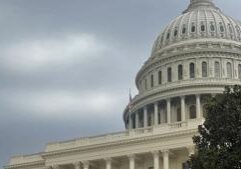
Federal debt expected to climb, but how much debt can U.S. carry?
The latest projections show U.S. debt will continue to grow over the next decade, hitting 120% of gross domestic product by 2036, raising questions about how much debt the world’s largest economy can support.
The Congressional Budget Office projects the federal government will borrow $26 trillion from late 2025 to 2036, raising public debt to $56 trillion, or 120% of GDP.
“Measured in relation to the size of the economy, that amount of debt would be the greatest in the nation’s history – more than double the 50-year average of 51% of GDP,” the CBO report noted.
Those CBO projections prompted fresh warnings for Congress about the federal debt.
Maya MacGuineas, president of the Committee for a Responsible Federal Budget, urged Congress to take action “before it is too late.”
Carolyn Bourdeaux, executive director of Concord Action, said federal lawmakers’ “continued fiscal irresponsibility constrains America’s ability to invest in national priorities and shakes investor confidence in our national financial footing.”
Michael Peterson, CEO of the Peter G. Peterson Foundation, called the CBO report “an urgent warning to our leaders about America’s costly fiscal path.”
Pinpointing just how much is too much has been difficult, but some guidelines exist. The International Monetary Fund has estimated that the U.S. debt could put the nation at risk of default when it climbs above 160% of GDP. Vanguard previously suggested 225%. The Penn Wharton Budget Model has suggested a limit of 200%.
“This 200% value is computed as an outer bound using various favorable assumptions: a more plausible value is closer to 175%, and, even then, it assumes that financial markets believe that the government will eventually implement an efficient closure rule,” according to PWBM. “Once financial markets believe otherwise, financial markets can unravel at smaller debt-GDP ratios.”
Treasury Secretary Scott Bessent told Congress last year that while it’s difficult to pinpoint a point of no return, the path ahead is clear.
“A tipping point in debt sustainability is very difficult to pinpoint, but what is not difficult to pinpoint is a trajectory and the trajectory is unsustainable when and if the markets were to rebel,” Bessent told the Subcommittee on Financial Services and General Government in May.
The CBO report said that growing debt could limit lawmakers’ policy options and lead to other serious consequences. The main risk is that a larger debt increases the likelihood of fiscal problems.
“The risk of a fiscal crisis – that is, a situation in which investors lose confidence in the value of the U.S. government’s debt – would increase,” it noted.






Showers And Thunderstorms
Latest News Stories

Executive Committee Approves Local Fire District Appointments, Faces Pushback Over Delayed Elwood Seat

Illinois Quick Hits: Illinois House approves student cell phone ban
Meeting Summary and Briefs: Will County Board Finance Committee for April 7, 2026
Ad-Hoc Committee: County’s Lack of Home Rule Stifles Effort to Ban Kratom and Non-Nicotine Vapes

Meeting Summary and Briefs: Will County Public Health & Safety Committee for April 2, 2026
Ex-Dem Rep. Stoneback can’t sue gun control group, current Rep. Olickal over NRA smears

Meeting Summary and Briefs: Frankfort Village Board for April 6, 2026

Indiana Man Faces Federal Indictment, Potential Death Penalty for Momence Bar Owner’s Murder
Ad-Hoc Committee: New State Laws Force Shift in How Police Handle Student Cannabis and Tobacco Violations
Peotone Township Homeowner Secures Porch P&Z Variance Despite Local Objection
Manhattan Township Property Owners Secure Zoning P&Z Approvals for Pole Barn Addition, Parcel Consolidation

FTC takes action against ad giants for avoiding certain sites