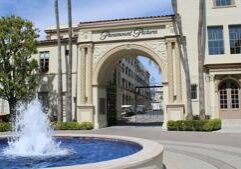
Judge plans to rule next week on Paramount, Warner Bros.
A federal judge plans to decide by Wednesday whether to grant a temporary restraining order in a case that pits state attorneys general against Warner Bros. Discovery and Paramount Skydance.
A TRO is an emergency, short-term injunction issued by a judge to freeze a situation immediately.
Friday’s arguments in the case were held in the U.S. District Court for the Northern District of California in Oakland. Judge Araceli Martínez-Olguín presided over the proceedings.
“You will get a ruling by the 22nd,” said Martínez-Olguín.
Warner Bros. Discovery and Paramount Skydance want to merge in a deal worth $110 billion. Both operate studios that are iconic parts of movie history: Warner Bros. Studios in Burbank, Calif., and Paramount Pictures, about 26 miles away in Hollywood.
California Attorney General Rob Bonta is leading a coalition of fellow Democratic attorneys general seeking to block the merger. Earlier this week, Bonta announced the lawsuit, in which 12 states are trying to stop Paramount Skydance’s purchase of Warner Bros. Discovery.
“It would result in higher prices, lower content quality, and fewer movies and TV shows,” said Bonta in a Monday press conference with the famous Hollywood sign on the hill behind him. “Movie theaters, basic cable TV distributors and audiences on every sofa and in every movie seat would feel the impact of this unlawful merger.”
Bonta added that movies and television programs are not run-of-the-mill commodities.
“The film and entertainment industry doesn’t exist just to buy and to sell them,” said Bonta. “It exists to tell stories, to spark ideas and spark curiosity, to inspire and sometimes to inform, to open our eyes to new perspectives we may have never considered before, to expose us to the things we don’t know we need to be exposed to.”
Warner Bros. Discovery and Paramount Skydance want to join forces to better compete against streaming services like Netflix. Revenue has also been drying up at traditional cable television networks, where Warner Bros. Discovery has channels in operation, such as CNN, TNT and Turner Classic Movies. Paramount Skydance also owns television networks including CBS. In addition, Warner Bros. Discovery owns the HBO Max streaming service, and Paramount Skydance’s streaming service is Paramount+.
James Weingarten, the attorney for the plaintiff states, said this is the “largest merger in Hollywood history.”
Weingarten added that the merger would combine two of the five major film studios and more than 50 basic cable channels.
“After this merger, as our papers show, for every dollar that is generated in America through box office. this combined company is going to pocket more than a quarter of every dollar,” said Weingarten.
Jeffrey Kessler, the attorney hired by Paramount to defend its acquisition of Warner Bros. Discovery, said they have not made their case.
“We do not think they should get a TRO,” said Kessler.
In addition to the states’ attorneys general, Writers Guild of America West and Writers Guild of America East filed a suit to block the merger.




Mostly Sunny
Latest News Stories
Trump administration begins axing positions of furloughed federal workers
Fiscal Fallout: Illinois has among highest-paid state employees

Report: State reliance on federal funds up significantly since 1990s

Southwest low on list of safest states; Northeast at the top
Washington state attorney general agrees to protect seal of confession
Pacific Northwest journalists sound off on Antifa at President Trump’s roundtable
Nvidia will pay 100k visa fees, others unsure

‘Shameful:’ GOP leaders frustrated with Dems on tenth day of shutdown

Trump snubbed by Nobel Committee, praised by winner
Will County Committee Approves Preliminary $161.6M Tax Levy on Split Vote Amid Heated Debate Over Spending
Will County Eyes Major Overhaul to Consolidate Scattered Government Offices
Trump threatens tariffs on China over ‘hostile’ rare earths policy
Illinois legislator urges school discipline to focus on behavior, not race

WATCH: Trump appeals Guard TRO as DHS looks to ‘double down’ law enforcement in Chicago