Trump demands Republicans attach voter ID bill to $350 billion for Pentagon
As congressional Republicans recuperate from weeks of disrupted work, President Donald Trump is doubling down on two policy goals consider long-shots by observers: an extra $350 billion for the Pentagon and a nationwide voter ID mandate.
In a Tuesday social media post praising the U.S. military, Trump called on Republicans in Congress to pass a third party-line budget reconciliation bill that would incorporate both the $350 billion defense funding supplemental and the SAVE America Act.
“I am calling on House and Senate Leadership to make this their Number One Priority, and ensure that 350 Billion Dollars in Recon 3.0 moves out of the Budget Committee as soon as Congress is back in session,” he wrote.
“The SAVE AMERICA ACT, which everyone is asking for, paired with the full funding of our Great Department of War, can be passed very quickly, ensuring that the United States of America stays FREE for Generations to come.”
While neither demand is new by itself, Trump’s desire to attach national defense funding to an election bill that many think won’t pass marks yet another instance of the president pushing Republican leaders to pass the SAVE America Act via any legislative vehicle available.
His pressure tactics have already obstructed progress on multiple critical bills — including, ironically, the House’s $1.14 trillion National Defense Authorization Act, which sets Pentagon funding levels for the upcoming fiscal year 2027.
House Republican leadership had planned to fulfill the White House’s unprecedented $1.5 trillion national defense spending request by allocating $1.14 trillion through bipartisan annual appropriations for the Department of War and the remaining $350 billion via a budget reconciliation bill.
But the House’s version of the NDAA failed to reach the floor last week due to Republican infighting, when a group of Trump loyalists blocked the bill’s advance because it did not include the SAVE America Act as an amendment.
Trump’s newest demand that Republicans instead attach the SAVE America Act to their upcoming budget reconciliation bill is hardly a way out, because Senate rules prevent the inclusion of non-budgetary policies – such as voter ID mandates – into budget reconciliation bills.
While House Speaker Mike Johnson, R-La., has floated the idea of using budget reconciliation to create a $4 billion fund rewarding states that implement voter ID checks; incorporating the SAVE America Act wholesale into filibuster-proof legislation is untenable.
The bill, currently languishing in the Senate after passing the House, mandates that Americans display a valid ID to vote in federal elections and requires people to present proof of citizenship when registering to vote.
It also necessitates in-person voter registration for federal elections and directs states to remove all noncitizens from their voter rolls.
Trump and Republican hardliners argue that passing the legislation would hand Republicans the key to victory in the 2026 midterm elections because it would prevent voter fraud, which the president claims is the reason he lost to Joe Biden in 2020.
The SAVE America Act battles, however, are preventing Republicans from scoring policy wins just months before the midterms, stalling major bipartisan bills funding American farms, transportation, and water infrastructure.






Scattered Showers And Thunderstorms
Latest News Stories
WATCH: Sonya Massey bill requiring full employment history for police candidates now law

Chicago group says Illinois officials break laws as they blast Trump
Pritzker continues fielding presidential question ahead of State Fair rally

WATCH: Illinois In Focus Daily | Tuesday Aug. 12th, 2025

About Us

Everyday Economics: CPI takes center stage as tariff-driven price pressures mount

Net negative migration is harmful to the economy, economists say

Details pending on billions in foreign investments coming from trade deals
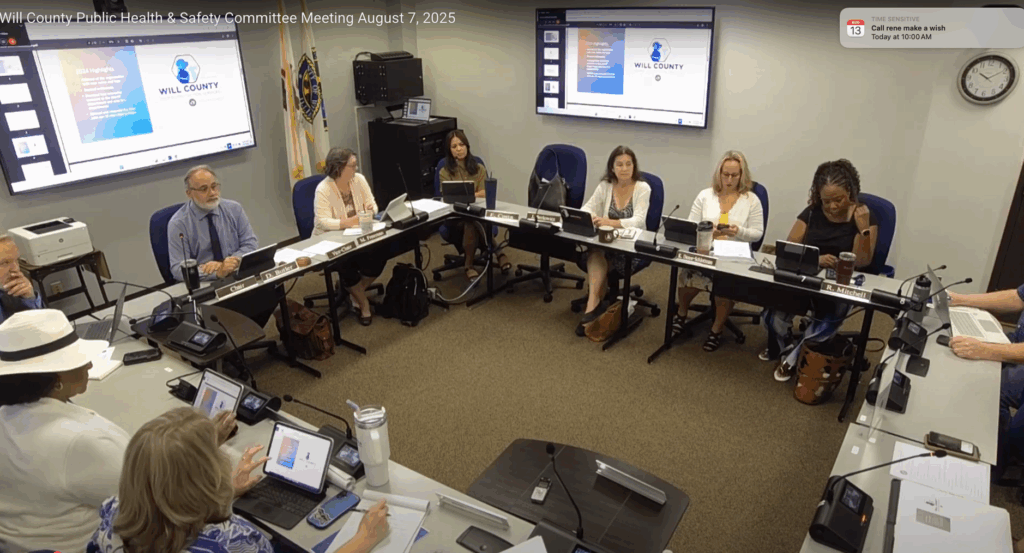
Will County Health Department Seeks $1 Million to Avert ‘Drastic’ Service Cuts from Expiring Grants
Will County’s “First-in-Nation” Veterans Center to House Workforce Services, Sparking Debate
Improved Vendor Service Creates $1.2 Million Shortfall in Sheriff’s Medical Budget
Will County Public Works Committee Unveils 25-Year Transportation Plan, Projects $258 Million Gap
Will County Animal Protection Services Seeks New Facility Amid “Gaping Wound” of Space Crisis