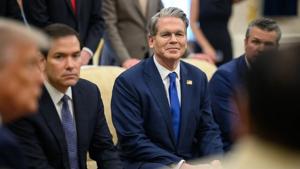
Vought cites $30B war cost as his agency seeks $67B for conflict
Office of Management and Budget Director Russell Vought told Congress the Iran conflict has cost “about $30 billion,” six days after his own agency asked lawmakers for $67.1 billion to cover the same conflict’s costs.
Neither Vought nor lawmakers reconciled the two figures during the June 30 hearing, even as Congress weighs a request that works out to about $412 for each of the nation’s estimated 162.8 million individual income tax filers, according to IRS data.
Rep. Mark Pocan, D-Wis., asked Vought during the hearing how much the conflict, formally called Operation Epic Fury, has cost.
“We’ve spent about $30 billion,” Vought said.
When Pocan noted some estimates run closer to $100 billion, Vought said the figure came from the Department of War, not an independent OMB assessment.
“That’s the number that I have,” he said.
The $30 billion cost figure marks the third number in three hearings. The Center Square reported in April that Jules Hurst III, then the Pentagon’s acting undersecretary of war for finances, put Iran conflict costs at $25 billion at the time. He raised that estimate to $29 billion before the House Appropriations Committee in May testimony, including $24 billion in munitions and equipment replacement costs. He said the Pentagon did not have a cost estimate for damage to U.S. installations in the region.
Vought had sent a letter to House Speaker Mike Johnson on June 24 requesting $87.6 billion in supplemental funding, including $67.1 billion for the Department of War tied to the conflict. The request included $21 billion for munitions, $17.3 billion for “operational costs” and $12.1 billion for unspecified classified programs, according to the letter.
Those three line items alone total $50.4 billion, 68% more than the $30 billion Vought cited in his testimony. The remaining $16.7 billion funds seven other categories in the letter, including cybersecurity, drones and National Guard support.
Vought told U.S. Rep. Rick Larsen, D-Wash., during the same hearing that the request covers both costs already incurred and multi-year procurement “booked in the first year” to rebuild military stockpiles. He did not specify how much of the $67.1 billion falls into each category.
Sen. Patty Murray, D-Wash., opposed the request, saying the Department of War already “sits on over $100 billion in unspent funding” from an earlier reconciliation bill. Vought did not dispute that figure when a lawmaker raised it separately during the same hearing.
The Center for Strategic and International Studies, a Washington think tank that has tracked costs since the conflict began, estimated in a June 23 analysis that total costs of Operation Epic Fury ran between $34 billion and $42 billion, closer to Vought’s $30 billion figure than to the $67.1 billion request.
Moody’s Analytics chief economist Mark Zandi estimated in a June 25 analysis that the war has cost the typical American household $1,000 so far, including $250 tied directly to military spending. Zandi called the figure conservative, writing that “the true cost is likely higher – meaningfully higher.”
OMB and Murray’s office did not respond to requests for comment by deadline Thursday. A Department of War duty officer told The Center Square the department had “nothing additional to provide” when asked about the figures.
Congress is weighing whether to approve the $67.1 billion request without a reconciled figure for what Operation Epic Fury has actually cost.





Partly Sunny then Isolated Showers And Thunderstorms
Latest News Stories

Former HHS secretary tied to company that could benefit from CMS screening proposal

Supreme Court rules against Verizon, AT&T over privacy penalties

Illinois quick hits: Stop child care scams act clears U.S. House, Illinois U.S. Reps introduce immigrant due process bill
Trump to tap Blanche as attorney general

Trump signs executive orders on customs, federal workforce reforms

McCuskey eyes delay, reversal of furnace, water heater rules

Pratt, Bass on track to face each other in Nov. 3 mayoral race

Kiley, Wahab, Desmond hold onto leads in House districts

GOP maintains leads despite congressional redistricting

WATCH: Trump acknowledges Iranian hardliners could jeopardize deal

Advocates applaud, condemn SPLC wire fraud charges

Gallagher elected to serve rest of LaMalfa’s term in Congress