Colorado gubernatorial candidates debate economic issues
Two Democrats and three Republicans have pulled ahead in Colorado’s crowded race for the soon-to-be vacant Governor’s Office.
Following Democratic Gov. Jared Polis’ term limit, candidates looking to fill the seat are debating the economy, government accountability, the environment and public safety. Five candidates, including the current state attorney general and a U.S. senator, have dominated debates and headlines.
As has been the case across much of the country, Colorado’s candidates for governor have centered much of their campaigns around the economy.
Democratic candidate and Attorney General Phil Weiser said he would focus on expanding affordable housing by reducing regulations and prioritizing essential workers’ ability to get a home. Those workers would include teachers and nurses.
“Permitting fees are so high, permitting timetables take so long, and it’s the same whether you’re building a starter home or a mega mansion,” Weiser said at a June Democratic primary debate. “When I’m governor, we’re going to change that. We’re going to make permitting fees lower to build starter homes, make it quicker to change this equation and provide down payment assistance for essential workers so they can buy the homes that they deserve to have.”
The other Democratic candidate, U.S. Sen. Michael Bennet, has also endorsed a similar solution of reducing regulation to the state’s housing development as a means to the affordability issue.
“To slash the red tape at the state level, but also at the local level to make sure that Colorado can finance workforce housing again in our state, and that the private sector isn’t ignoring Colorado because it’s too hard to build here,” said Bennet in the June debate.
The three Republican candidates have largely agreed on similar housing proposals. State Rep. Scott Bottoms, R-El Paso County, said he would focus on getting rid of regulations that make building homes in the state more expensive, according to his campaign.
State Sen. Barb Kirkmeyer, R-Larimer and Weld counties, said she would “Lower Grocery and Home construction costs by repealing onerous regulations and increasing water supply,” according to her election website.
Kirkmeyer and Bottoms did not respond to a request for an interview by The Center Square.
According to World Population Review, Colorado ranked fifth highest among states with a median home value at $539,400 in 2024.
The three frontrunner Republican candidates have focused on public safety during their campaigns.
Republican candidate and nonprofit founder Victor Marx said the state needed to expand programs to fight fentanyl and fill shortages in police enforcement across the state.
“As Governor, I will require the Department of Public Safety to conduct statewide staffing and training assessments under C.R.S. § 24-33.5-401 et seq. to identify shortages in patrol coverage, investigative capacity, and officer safety resources,” read Marx’s campaign website. He did not respond to a request for an interview by The Center Square.
The two Democratic candidates have highlighted Colorado’s environmental struggles, which come as the state experiences a drought in all counties and is locked in negotiations with neighboring states over Colorado River water rights.
“We’ve made some good progress as a state, but I think we can lead all 50 states,” Bennet said during the Democratic primary debate. “And I’m proud that Conservation Colorado and other environmental groups have endorsed my cap-and-dividend plan.”
According to a statement by Bennet’s campaign, his cap-and-invest environmental program would progressively cap greenhouse gas emissions, at still unspecified amounts, and increase investment into renewable energy in the state.
“The future is solar, it’s storage, and the way we drive it is through effective leadership and our public utilities commission, ensuring that we’re getting more competition, more innovation closer to users,” Weiser said at the Democratic debate. He added that he wanted Colorado’s energy to be created from within the state.
Weiser and Bennet did not respond to The Center Square’s requests for an interview.
Both Democratic candidates have so far outraised the three Republican candidates. Weiser led the pack with over $6.5 million in total contributions, followed by Bennet at more than $4.8 million. Marx led the Republicans with just shy of $2.8 million, trailed by Kirkmeyer at $608,000 and $227,000 for Bottoms.
Reports by the Secretary of State’s Office did not make it immediately clear who gave the most money to the various campaigns.
Polls are open from 7 a.m. to 7 p.m. on June 30, Election Day. For more information, visit the Secretary of State’s website, coloradosos.gov/pubs/elections. Early election results will be published that evening at www.thecentersquare.com/colorado.




Partly Sunny then Chance Showers And Thunderstorms
Latest News Stories

Details pending on billions in foreign investments coming from trade deals
Will County Health Department Seeks $1 Million to Avert ‘Drastic’ Service Cuts from Expiring Grants
Will County’s “First-in-Nation” Veterans Center to House Workforce Services, Sparking Debate
Improved Vendor Service Creates $1.2 Million Shortfall in Sheriff’s Medical Budget
Will County Public Works Committee Unveils 25-Year Transportation Plan, Projects $258 Million Gap
Will County Animal Protection Services Seeks New Facility Amid “Gaping Wound” of Space Crisis
Board Confronts Animal Services Crowding, Explores Future Facility Options
Will County Board Members Demand Transparency in Cannabis Tax Fund Allocation
Homer Glenn Residents Push Back on 143rd Street Widening as Officials Signal “Tentative Agreement”
Will County Forges 2026 Federal Agenda Amid D.C. Policy Shifts, ‘Big Beautiful Bill’ Impacts
Health Department Seeks $1 Million Levy Increase to Prevent “Weakened System”
County Rolls Out New “OneMeeting” Software to Improve Public Access

Meeting Summary and Briefs: Will County Board Finance Committee for August 5, 2025
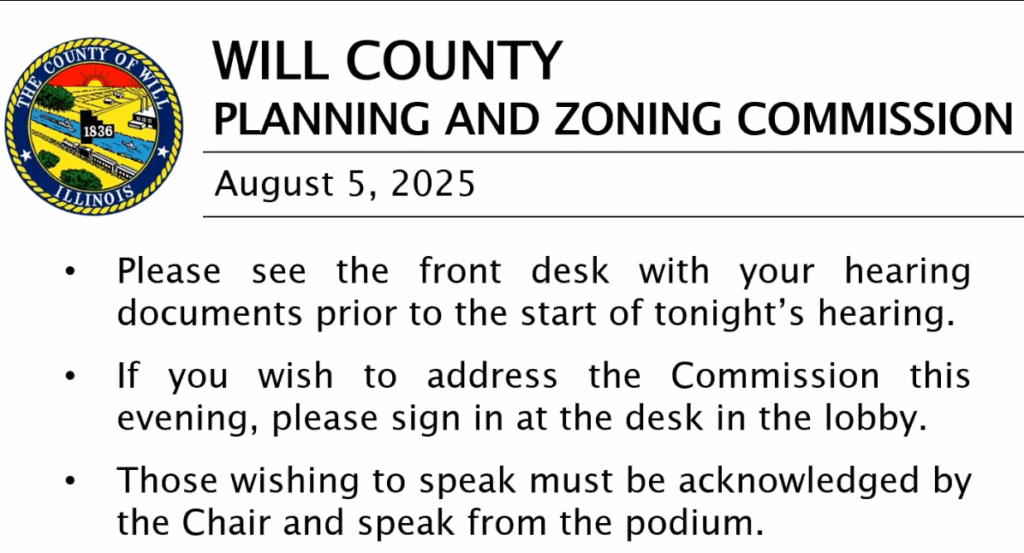
Will County PZC Approves Rezoning for Truck Repair Facility on Manhattan Road Amid Resident Concerns