
Everyday Economics: A new chair, a shorter statement, a Fed that stopped talking cuts
The Federal Reserve left interest rates alone last Wednesday, holding its benchmark in the 3.50%–3.75% range for a fourth straight meeting – after standing pat in January, March, and April – in a unanimous 12–0 vote. That part was expected. The news was everything around the decision, because this was Kevin Warsh’s first meeting as Fed chair, and he used it to signal that the central bank is no longer leaning toward cutting rates. If anything, it is now leaning the other way.
What actually changed
Start with the statement itself, the short document the Fed releases after every meeting. Under Jerome Powell, these had grown past 300 words (counting the voting paragraph) and carried an “easing bias” – a sentence that quietly told markets the next move was likely a cut. That sentence had already become contentious: at the April meeting, several officials supported holding rates but objected to keeping the easing-bias language in the statement at all. Warsh resolved the argument by cutting it. The June statement ran about 115 words, the easing-bias language was gone, and the forward guidance markets had leaned on for years was simply dropped. Warsh told reporters the new version “just gives you the facts, as best we can judge it.”
That is a real break from his predecessor. Powell’s press conferences were long, careful, and built around managing expectations sentence by sentence. Warsh’s first outing was blunter and more institutional: he announced five internal review task forces – covering the Fed’s inflation framework, productivity and jobs (including how much artificial intelligence is reshaping the economy), data and methodology, communications, and the balance sheet – and said he wanted vigorous internal debate, a “good family fight,” before settling on changes. He even declined to submit his own interest-rate projection, consistent with his long-standing skepticism about the value of the Fed’s dot plot.
The dot plot he kept did the talking anyway. The story is the shift in its center of gravity: in March the projections still carried a cut bias, and by June they had tilted toward a slight hiking bias. The median year-end projection moved up to 3.8% from 3.4% in March, just above today’s setting, and the committee was split: of the 18 participants, nine placed their year-end dot above the current midpoint, eight saw no change, and only one still penciled in a cut. Nearly all judged the risks to inflation to be tilted upward.
Why the hawkish turn? Inflation has reaccelerated. The Fed raised its year-end forecast for headline PCE inflation to 3.6%, up sharply from 2.7% in March, and core inflation to 3.3%. It trimmed its growth outlook slightly to 2.2% and nudged its unemployment forecast down to 4.3%. Much of the price pressure traces to an energy shock tied to the conflict in the Middle East – and here lies the genuine debate inside the Fed. The internal question is whether that energy shock stays a contained relative-price move or spills into broader inflation. Warsh has emphasized the role of supply-side forces, including AI and productivity, but his first message as chair was still unambiguous: the Fed intends to deliver price stability. A stable job market that has not continued to deteriorate gives policymakers little reason to rush.
Why the Taylor rule says ‘hold,’ not ‘cut’
For readers who want the logic in one tidy framework, the Taylor rule is the workhorse. It doesn’t treat the Fed’s two jobs as separate switches – it balances them. The rule starts from a neutral interest rate and then layers on two adjustments at the same time: one for how far inflation sits from the 2% target, and one for how far the economy is from full employment (usually measured by the gap between unemployment and its long-run rate). Each adjustment cuts both ways. Inflation above 2% pushes the prescribed rate up and inflation below 2% pulls it down; a labor market running hotter than full employment pushes the rate up, while slack – unemployment above its long-run level – pulls it down. The rule adds the two together. It is a rule of thumb, not gospel, but it captures how a central bank is supposed to weigh price stability and employment in a single number.
Plug in today’s numbers and the rule offers no excuse to cut. Unemployment is 4.3%, essentially equal to the Fed’s own estimate of its long-run rate of about 4.2%. In plain terms: the labor market shows no meaningful slack, so the employment adjustment is close to zero. May payrolls still grew by 172,000. With the employment side roughly neutral, the inflation adjustment does the work – and with inflation well above 2%, that pushes the prescribed rate up. The rule’s verdict is straightforward: policy should hold at minimum and lean toward tightening.
How much tightening depends entirely on which inflation number you feed the rule. Use today’s elevated readings – headline CPI ran 4.2% over the year in May, though core was milder at 2.9% (and just 0.2% on the month) – and a mechanical Taylor rule points to a policy rate well above the current 3.5%–3.75%, suggesting the Fed is, if anything, a touch too easy. Use a measure that strips out the energy spike, and the prescribed rate lands much closer to where rates already are. That single judgment call – is this inflation temporary or sticky? – is the whole ballgame, and it is why the Fed chose to wait and watch rather than move.
There is good reason to expect the temporary reading to win out. An energy shock is a one-time step up in the level of prices, not a self-sustaining spiral. It lifts year-over-year inflation now because today’s prices sit above last year’s – but a one-time jump does not keep repeating. Twelve months on, the higher level is baked into the comparison, and the inflation rate mechanically falls back toward target, as long as the shock does not leak into wages and expectations. In that sense, an oil spike behaves less like classic demand-driven inflation and more like a tax: it drains spending power from households and businesses and hands it to energy producers, cooling demand for everything else. A shock that is both self-reversing and demand-sapping is not one a central bank wants to meet with rate hikes – doing so would only compound the squeeze. That is the likely logic behind the hold: keep policy restrictive enough to guard against the inflation seeping into expectations (hence no cut, and no easing bias), but resist tightening into a shock that is already taxing the economy and should fade on its own.
The week ahead
Two releases will test that “wait and watch” posture.
Wednesday, June 24 — New home sales (May). The April report was soft: sales of newly built single-family homes fell 6.2% to a 622,000 annual pace, the slowest in three months, with inventory at about 9.4 months’ supply. The price data tell a subtler story worth watching again this week – though Census attaches wide margins of error to these figures, so the year-over-year moves are suggestive rather than statistically clean. The median new-home price was $422,500, up about 2% from a year earlier, while the average price, $508,800, was down about 1% over the same span. When the average slips while the median holds up, the price mix is usually shifting toward smaller, cheaper homes.
The square-footage data point the same way, and more cleanly. According to Zillow, the median price per square foot for newly built homes is down 1.55% from a year ago. Builders, squeezed by high mortgage rates and stretched buyers, are responding the way the textbook predicts: not by slashing sticker prices, which is hard, but by building smaller. The homes coming to market and finding buyers are physically shrinking. That is a quieter form of affordability adjustment – a sign that potential buyers are barely making it work and that price cuts and other incentives are here to stay.
Thursday, June 25 — PCE inflation (May). This is the big one. PCE is the Fed’s preferred inflation gauge, and after a hot, headline CPI report and the Fed’s own upward revision to its inflation forecast, this release will show whether the energy-driven pickup is bleeding into the broader basket or staying contained. A core reading that stays firm would validate the dot plot’s hawkish shift and put a midyear hike squarely on the table. A softer print would ease the pressure and support a patient hold.
For now, the message from the Fed is simpler than it has been in years: rate cuts are off the menu and the burden of proof has shifted to the data. But if the energy spike proves to be the one-time tax it looks like, the inflation that flipped the dot plot should ebb later this year – and the case for a hike could ebb with it. A new chair has made his style clear; the data over the next few months will decide which way he leans.





Mostly Sunny
Latest News Stories

In Split 4-2 Vote, Summit Hill 161 Board Approves MacBook Pilot

National Guard member shot near White House dies

New Bar Approved in Frankfort Despite Board Opposition
Meeting Summary and Briefs: Frankfort Square Park District for October 16, 2025

Chicago tenant groups call for eviction moratorium amid ICE raids

Illinois tax proposals dampen decline in small business uncertainty index

JJC Board Approves Grundy County Land Purchase Amid Heated Debate

‘Trouble in Toyland’ report sounds alarm on AI toys
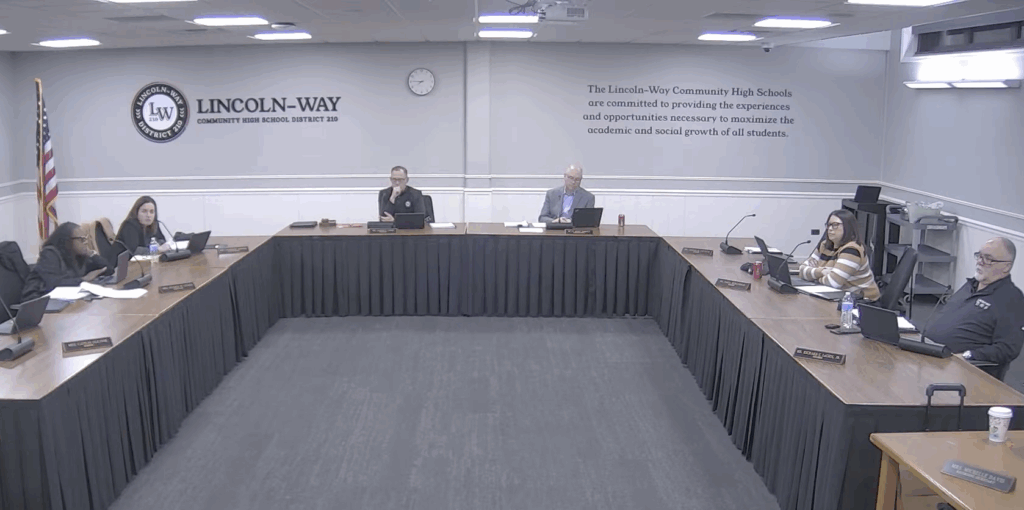
Support Staff Urge Lincoln-Way 210 Board for ‘Fair Contract’ During Public Comment

When was the first Thanksgiving? It’s actually up for debate

Frankfort 157-C Faces Steep Insurance Hikes, Projects $5.5 Million Cost for 2026

Frankfort Park District Approves Settlement with Five Oaks HOA, Pending Homeowner Vote