
Poll: Most Americans don’t trust AI for news
Most Americans say they do not trust artificial intelligence to provide accurate and unbiased information about politics and current events, according to a new poll.
The Center Square’s Voters Voice Poll, conducted by Noble Predictive Insights, found 57% of American voters either trust AI “not very much” or “not at all” when it comes to providing accurate and unbiased information. Among the split, 29% of voters said they did not trust it “very much” and 28% of voters said they did not trust it “at all.”
The poll, conducted June 1 to June 4, surveyed 2,585 respondents about their opinions on a wide range of issues, including artificial intelligence. Among respondents, 915 identified as Republicans, 1,013 identified as Democrats, and 297 identified as true independent voters, which means they did not lean toward either party when asked.
Across partisan divides, respondents showed relatively similar stances on trust in AI for information. About 39% of Republicans said they trust AI “a great deal” for information on politics and current events, while 34% of Democrats said the same.
About 28% of True independent voters said they would trust AI “a great deal” for information on politics and current events.
The biggest divide in trust of AI came between younger and older respondents. About 54% of respondents ages 18-29 do not have much trust for AI, compared to 64% of respondents older than 65.
Mike Noble, founder of Noble Predictive Insights, said the difference in trust between younger and older generations comes down to the prevalence of technology.
“There’s a big gap between the two on their technological experience,” Noble told The Center Square. “Older folks are definitely much less trustworthy when it comes to AI being able to deliver the news.”
However, Noble noted that trust for AI to deliver the news overall is extremely low, regardless of the demographic.
Respondents with greater educational backgrounds and higher household incomes were more likely to trust AI “a great deal” to deliver information on politics and current events. About 40% of respondents with a college degree said they trust AI “a great deal” to deliver news and events, compared to 34% of respondents with no college degree who said the same.
“The lower education you have, the less kind of plugged in you are, the more concerned you are regarding it,” Noble said.
Roughly 42% of respondents with a household income above $100,000 per year said they trust AI “a great deal” to deliver information on politics and current events, compared to 32% of respondents with a household income under $50,000 per year who said the same.
Noble emphasized the trust among younger respondents as key to understanding the acceptance of AI. However, he said it will likely not be used to replace traditional news anytime soon.
“18-29 [year olds] grew up with it, they’re just more open to it, and again, just have leaned on it more,” Noble said.






Showers And Thunderstorms
Latest News Stories
Judge expands restraining order against ‘Beto’ O’Rourke, adds ActBlue
Executive Committee Members Decry Roadside Litter, Call for Action Against Garbage Haulers
Reversing Biden’s precedent, students complete FAFSA in minutes at beta-testing event

Trump, Zelenskyy to meet Monday in steps toward peace with Russia

Possible ‘agreement’ reached in Trump-Putin meeting; more discussion likely

WATCH: Gun rights supporters celebrate 9th Circuit’s ruling against CA gun rationing law

Feds sue California over emission standards for trucks
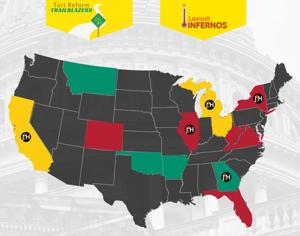
Illinois quick hits: ‘Lawsuit inferno’ bill takes effect after Pritzker signed 267 measures Friday

WATCH: UW-authored study on surgery times contradicts CMS basis for reimbursement cuts

State defends gun ban district court ruled unconstitutional

Trump aiming for ceasefire, world awaiting news from Putin summit

Pritzker acts upon 269 bills, vetoes 2, signs ‘lawsuit inferno’ measure