
Supreme Court backs gun rights for marijuana users in 9-0 decision
Gun rights advocates celebrated the U.S. Supreme Court’s decision on Thursday to allow occasional marijuana users to possess firearms.
Justices on the high court ruled unanimously to allow Ali Hemani, a man found with marijuana, cocaine and a pistol in his home to keep his Second Amendment rights. John Commerford, executive director of the National Rifle Association Institute for Legislative Action, told The Center Square it was “encouraging” to see a unanimous decision from the high court in favor of the Second Amendment.
“Any time you see the U.S. Supreme Court issue a 9-0 decision, it gets your attention,” he told The Center Square. “The U.S. government cannot deprive you of your core constitutional rights simply because you chose to be an occasional marijuana user.”
Commerford said he was particularly encouraged to see justices on the high court reference the pre-deprivation process, where an individual can get a gun confiscated before it is proven whether they broke the law. In Hemani’s case, the government argued his firearm could be confiscated as soon as he became an unlawful drug user and until he stopped using the drug unlawfully.
Justices on the high court disagreed on the ability of a pre-deprivation process to move forward. Commerford said this could indicate a willingness on the court to review cases on red flag laws, regulations that prevent individuals from obtaining a firearm if they are deemed a risk to themselves or others.
“This opinion opens up the door to multiple technical challenges in the future on a host of different issues where Second Amendment rights are taken away without adequate due process, so it’s going to be very fascinating to see the legal landscape around gun policy develop,” Commerford said.
Amy Swearer, a senior legal fellow at Advancing American Freedom, said the decision has reinforced the Supreme Court’s need to review red flag laws and the pre-deprivation process as a whole.
The case reinforced a test developed after the 2022 decision, New York Rifle and Pistol Association v. Bruen, where the court determined further laws restricting Second Amendment rights needed to be supported by a historical precedent.
The government argued that founding-era laws prohibiting drunkards from certain activities in public spaces were not sufficient to support the ban on occasional marijuana users.
“The opinion reinforces that historical tradition that you need to rely on the context of the history of this country when you’re enforcing constitutional rights,” Commerford said.
Swearer told The Center Square the process for analyzing historical laws has revealed that most people have been afforded a pre-deprivation process.
“It is important that in analyzing these historical laws, that is an aspect that routinely comes up, is that they were afforded some sort of pre-deprivation process, to at least some degree, even before a temporary deprivation of their rights,” Swearer told The Center Square.
While justices on the court remained unanimous in their decision, Justice Clarence Thomas argued that the federal law barring Hemani from obtaining a firearm could be seen as a violation of the Commerce Clause. He said the law allows Congress to improperly regulate items that never crossed state lines and called on the judiciary to take a deeper look into the issue.
“The Government can secure a conviction for unlawful firearm possession ‘if the firearm possessed’ by the drug user ‘had previously traveled in interstate commerce,’” Thomas wrote. “The Commerce Clause does not authorize Congress to ‘regulate or ban possession of any item that has ever been offered for sale or crossed state lines.’”
Swearer said she agreed with Thomas but did not think his arguments would be raised.
“I just don’t see the court looking at this under the Commerce Clause, or at least, having anything remotely resembling a majority that would choose to look at it that way,” Swearer said.
Justices on the high court have one more Second Amendment case on the docket before the term ends. Wolford v. Lopez challenges a Hawaii law banning concealed carry owners from entering private property open to the public without express permission from the owner.
“I’m extremely confident that the Second Amendment community will be successful in Wolford,” Commerford said.





Sunny
Latest News Stories

Homer Glen Man Charged with Reckless Discharge, Battery to Deputy Following Standoff

WATCH: Trump says U.S. will run Venezuela for foreseeable future

World leaders call for UN response after Maduro capture

Democrats slam Venezuelan strikes, Maduro capture

Trump sheds more light on Venezuela strike, Maduro capture
Congressional Republicans support Venezuela strikes, Maduro capture

With Maduro, wife in custody, Bondi says they will be tried on U.S. soil

District 157-C Schools Earn Top State Designations on 2025 Report Card
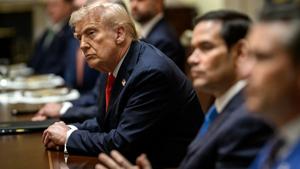
‘Large scale strike’ carried out against Venezuela; Maduro captured
Congress faces govt. shutdown date, health care bills, Epstein on return

U.S. Senate races will decide balance of Congress in 2026

9th Circuit rules against ban on open carry of firearms in most California counties

Trump: ‘Illinois is worse’ as HHS enforces verification for child care funding