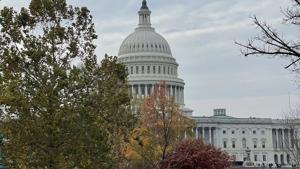
Supreme Court to hear jury limits, disability cases
The U.S. Supreme Court on Monday agreed to take up cases on intellectual disability in death sentences and limits on the number of jurors.
Justices on the high court are expected to hear the cases in the fall and release decisions for each in 2027.
One case, Guerrero v. Johnson, is set to determine to what extent intellectual disabilities should play a role in sentencing determinations for people convicted of a crime. The case focuses on Dexter Johnson, who was sentenced to death after being convicted for the kidnapping, rape and murder of Maria Aparece in 2006.
Johnson sought a claim of intellectual disability after his sentencing, which would have prevented him from being sentenced to death, according to previous Supreme Court precedent. Lawyers for Johnson used diagnostic tools in the DSM-V, published in 2013, to support his claim of intellectual disability.
“Before the DSM-5’s publication and acceptance, Mr. Johnson had ‘no possibility of merit.’ But because the criteria for assessing intellectual disability has changed, his claim now has possible merit,” lawyers for Johnson wrote.
Lawyers for Eric Guerrero, director of the Texas Department of Criminal Justice’s Correctional Institutions Division, said Johnson’s claim to intellectual disability is not appropriate. The lawyers said Johnson could not make an argument based on evidence that has appeared since his initial sentence.
“This holding erases the strict limits on claims based on new evidence,” lawyers for Texas wrote. “It had no possibility of merit without the new evidence.”
Lawyers in Texas are pushing for stricter regulations on the kinds of evidence prisoners can use in avoiding a death sentence trial. Lower courts are split as to what extent new evidence can be used to make determinations.
Separately, the court also agreed to take up a case challenging a Florida jury trial. The case, Kian v. Florida, focuses on a challenge to Florida’s six-person jury allowance.
Typically, a jury is made up of 12 people. However, a six-person jury convicted Hamed Kian of practicing as a chiropractor without a license. Kian was sentenced to more than a year in prison.
According to Florida law, trials that are not to result in the death penalty can take place with a jury of less than 12 people. Connecticut, Indiana, Massachusetts, Utah and Arizona also allow for six-member juries on cases that do not involve the death penalty.
Lawyers for Kian said Supreme Court precedent, dating back to 1898, affirms that a jury must be made up of 12 people.
“Since the time of Magna Carta, the word ‘jury’ has been understood to mean a body of twelve,” lawyers for Kian said. “Because that understanding had been accepted since 1215, the Court reasoned, ‘[i]t must’ have been “that the word ‘jury’ ” in the Sixth Amendment was ‘placed in the constitution of the United States with reference to [that] meaning affixed to [it].’”
However, in a brief to the court, lawyers for Florida said the Supreme Court more recently affirmed its use of six-person juries for cases not involving the death penalty.
“For nearly as long as states have had a Sixth Amendment duty to provide criminal jury trials, this Court’s message to the people of Florida has been clear: the jury structure that they have settled on for a century and a half fulfills that duty,” lawyers for Florida wrote.
Justices on the high court will likely hear arguments in both of these cases in the fall and issue decisions by 2027.





Sunny
Latest News Stories

BlackRock summit to focus on workforce needed for U.S. infrastructure boom

Debate grows as states consider teacher strike bans

American gasoline prices increase most in one week since 2020

Presidents, governor honor late civil rights leader Jackson; mayor says tax the rich

Illinois Quick Hits: Rockford sex abuse suspect arrested

Lawmakers concerned over taxpayer burden of Iran conflict

Pritzker pushes back on Megaproject tax concerns

Measles spreads across some Southwestern states
EXCLUSIVE: Inside one Michigan town’s fight against solar expansion

Trump demands unconditional surrender from Iran, mentions regime change

Illinois pols react to Homeland Security secretary’s exit, reassignment

Illinois quick hits: Appeals court vacates use of force injunction; Charges filed for possession of sex abuse materials; Gas prices keep rising