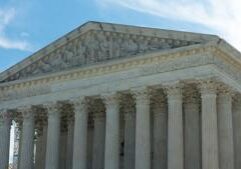
Gun rights, immigration to be decided at the U.S. Supreme Court
Several high profile cases on gun rights and immigration policy have yet to be decided by the U.S. Supreme Court as the court’s current term is set to end by July.
The high court has more than 20 cases it has yet to issue rulings on before the end of the term.
Gun rights issues in state legislatures across the country have taken a front seat along with the Trump administration’s immigration policies. Here is a look into some of those cases.
Gun Rights
Hawaii Gun Restrictions
In January, the high court heard arguments in Wolford v. Lopez, a case to determine whether the Hawaii legislature can restrict concealed carry permit holders from bringing a firearm to restaurants, bars, gas stations and other private property without the owner’s permission.
The case challenges precedent set by the Supreme Court’s decision in New York State Rifle and Pistol Association v. Bruen, where the justices struck down a New York state law requiring conceal-carry holders to display the need to defend themselves.
“The Second and Fourteenth Amendments protect an individual’s right to carry a handgun for self-defense outside the home,” Justice Clarence Thomas wrote in the court’s 2022 decision.
Thomas further elaborated that gun restrictions should only be upheld if they are consistent with the “historical tradition” of the United States.
Lawyers for the state of Hawaii argued that the Second Amendment, at the time of the nation’s founding, did not include the right to enter private property with a weapon.
“The Founders recognized a property owner’s right to exclude,” the lawyers wrote. “Accordingly, at the Founding, a person had no right to enter private property with a gun unless he had the owner’s express consent or an implied license based on local law or custom.”
Lawyers for conceal-carry gun owners in Hawaii argued Lopez relied on faulty evidence to assert other laws were similar to the state’s ban. They argued certain public spaces, like beaches and public parks, would not be considered in the original bans, which fundamentally alters the state’s argument.
“Under that approach, ‘the original understanding of the Second Amendment,’” the lawyers wrote, referencing a lower court judge’s opinion, “‘would not apply to any new types of public spaces that would develop in the future.’”
Drug User Gun Possession
Justices on the court also will decide whether regular drug users, including of marijuana, can possess firearms in U.S. v. Hemani.
The case focuses on Ali Hemani, a Texas man who was charged with a felony after FBI agents found a pistol, marijuana and cocaine in his home after obtaining a search warrant. Federal law bars a person who “is an unlawful user of or addicted to any controlled substance” from possessing a firearm.
“An individual’s Second Amendment rights are not restricted until a judge makes a finding of a credible safety threat to the safety of others,” lawyers for Hemani wrote in a brief to the court.
Justices on the high court appeared to favor Hemani’s arguments. Justice Amy Coney Barrett questioned how to determine whether a regular drug user is dangerous and could be barred from possessing a firearm. She asked whether a prescription drug like Ambien would be considered under the ban.
Lawyers for the Trump administration said the law could only temporarily disarm individuals who possess schedule I or schedule II drugs. This would include marijuana, heroin, fentanyl and morphine.
“By disqualifying only habitual users of illegal drugs from possessing firearms, the statute imposes a limited, inherently temporary restriction – one which the individual can remove at any time simply by ceasing his unlawful drug use,” Trump administration lawyers wrote.
Immigration
Temporary Protected Status
Justices on the high court also decided to hear two cases regarding temporary protected status for immigrants from Haiti and Syria living in the United States.
Trump v. Miot and Mullin v. Doe challenge temporary protected status for immigrants from Haiti and Syria, respectively. The special immigration status is provided for immigrants from countries that have experienced a war or natural disaster.
The Trump administration eliminated the protected status for both countries in 2025. However, lawyers for the Haitian and Syrian immigrants said the Trump administration did not properly consult other executive agencies or issue a notice before former Department of Homeland Security Secretary Kristi Noem terminated the status.
Solicitor General John Sauer argued that ending temporary protected status for Syrian and Haitian immigrants would project messages of confidence in the political systems of both countries. He pointed to the end of the civil war in Syria in 2024 as an example.
“If we don’t terminate TPS, it will send a sense of doubt about that decision,” Sauer said before the high court in April.
Asylum Processes
The high court is also tackling the issue of at what point an individual arrives in the United States they can claim asylum protections.
The case, Mullin v. Al Otro Lado, focuses on a dispute between the Trump administration and an immigration advocacy group. The advocacy group argued that the U.S. Department of Homeland Security instituted a policy to prevent migrants from attempting to cross the U.S.-Mexico border.
In a brief to the court, lawyers for the immigration advocates said border patrol officers standing on the U.S. side of the border “identified asylum seekers, and prevented them from stepping onto U.S. soil.”
The 1990 Immigration and Nationality Act allows an individual who “arrives in the United States” to apply for asylum status and be inspected by an immigration officer.
The case hinges on the definition of the term “arrives.” Lawyers for the Trump administration argue standing on the Mexico side of the U.S.-Mexico border is not sufficient to determine arrival.
Kelsi Cockran, a lawyer representing Al Otro Lado, said the determination of arrival is made once an individual is “at the threshold” of a port of entry “about to step over.”
Vivek Suri, a lawyer representing the Trump administration, argued the administration’s “metering” policy is designed to control the flow of individuals at ports of entry.
“Metering is not saying you can never enter the U.S. and the only option is to enter illegally,” Suri said. “The U.S. has greater responsibilities to those in the U.S. than those in Mexico.”
These cases and many more, including Trump’s desired change to end granting birthright citizenship to individuals born in the U.S. to noncitizen parents who are in the country illegally, will be decided in the coming weeks as justices prepare to wrap up the term.



Chance Showers And Thunderstorms
Latest News Stories

Summons issued to ISP, AG Cook County in FOID challenge
Pritzker knocks state progressives’ ability to pass new tax measures

Illinois Quick Hits: Pritzker talks Bears stadium with NFL commissioner
Election 2026: Whatley gets another breath of Trump tailwind

Op-Ed: Oversight faps in federal drug program put Illinois’ independent practices at risk
Costco suit highlights gaps in $166B tariff refund process

Support swells across the aisle for $580B BUILD America 250 Act

Revised bipartisan housing bill passes U.S. House, one step closer to becoming law

War of words reignites with Trump, Pritzker, Bailey
Nesbitt asks DOJ to investigate Whitmer’s ties to grant scandal
Senate Republicans’ rebellion in War Powers Resolution vote could sway House vote
Cassidy breaks with Trump on Iran, spending after reelection defeat

Nashville, state spent billions of taxpayer funds drawing Super Bowl

Judge won’t let ConAgra off hook in class action over fish fillet brine