Congress returns to backlog of must-pass legislation
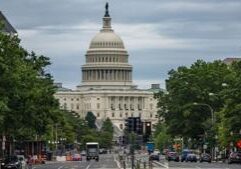
After leaving town for a week without sending a key immigration enforcement funding package to President Donald Trump’s desk, Congress returns Monday to a backlog of responsibilities.
Republicans’ $72 billion budget reconciliation bill, providing three years of advance annual funding for ICE and U.S. Border Patrol, failed to even receive a Senate floor vote last Friday, all but guaranteeing the legislation won’t make it to Trump’s desk by his June 21 deadline.
Senate Republicans ultimately deadlocked over whether to include restrictions on the Department of Justice’s controversial new “anti-weaponization fund” within the filibuster-proof bill.
Ironically, however, a Democrat-appointed federal judge may have just given congressional Republicans an out.
In response to a lawsuit filed over the $1.77 billion fund, Virginia-based Judge Leonie Brinkema issued a temporary restraining order that bars the DOJ from creating it, at least until June 12.
If Republican leaders in the Senate are able to convince politically vulnerable holdouts that legal challenges will ultimately prevent the fund’s creation, they might reclaim the Republican votes necessary for their $72 billion bill to advance.
But both Republican and Democratic leaders face interparty rebellion on many more upcoming legislative issues, particularly the looming expiration date of a controversial federal spying authority.
Unable to agree on whether to include privacy protections within a reauthorization of Section 702 of the Foreign Intelligence Surveillance Act, Congress punted on the issue and authorized a short-term extension.
That extension ends June 12, and lawmakers opposed to a clean reauthorization have not budged in their belief that FISA 702 effectively allows the government to violate Americans’ Fourth Amendment rights.
FISA 702 allows federal intelligence agencies to conduct warrantless electronic surveillance on foreign nationals under suspicion.
But the electronic data of American citizens – including emails, text messages, and phone calls – are routinely collected as well, and federal intelligence agents will routinely search through that database without obtaining a warrant.
Other major, time-sensitive legislation embroiled in debate includes the 21st Century ROAD to Housing Act, which initially passed the Senate but now heads back as an amended version after the House changed it.
The lower chamber weakened the bill’s restrictions on private equity buying up single-family homes and turning them into permanent rentals. House lawmakers backing the amendment bill argued that forcing institutional investors to eventually sell properties could displace renters, disrupt markets and inhibit growth.
All but ten senators had opposed the passage of the 21st Century ROAD to Housing Act, making it likely that the House’s amendment will face a chilly reception.
Congress will also attempt to make progress on the long-overdue bipartisan Farm Bill and $580 billion federal highway bill, as well as the SECURE Data Act – nominally a data privacy protection bill.
Despite the massive legislative backlog, the House does not plan to hold any votes until Wednesday.
As of May 30, 2026, both chambers of the 119th Congress have spent more than double their legislative workdays on recess or vacation than they have in session, according to the Congress.gov schedule.
U.S. House members have so far spent a total of 74 days in session and nearly 170 weekdays in recess. U.S. senators have so far spent a total of 79 days in session and nearly 160 weekdays in recess.




Showers And Thunderstorms Likely then Chance Showers And Thunderstorms
Latest News Stories
National shutdown, strike planned for Friday, Jan. 30 in protest of ICE

Gori firm accused of fraud, racketeering, ‘bounties’ in asbestos litigation

WATCH: Democratic legislators introduce anti-ICE legislation

Illinois Quick Hits: Grayson gets 20 years for murder
Bill Cassidy, facing Trump-backed challenger, bets on ‘who delivers’
Trump Cabinet meeting: New Fed chair, coal saving lives, Russia and Ukraine
Paul introduces legislation to halt welfare funding for non-citizens

Food companies push back on Pennsylvania bills to ban certain food products

Pritzker, Johnson express concerns about 2028 DNC with Trump in office

Pritzker looks for rules for federal school choice scholarship program

Ex-deputy sentenced to 20 years in prison for killing Sonya Massey

Chicago homelessness on rise; advocates push for change