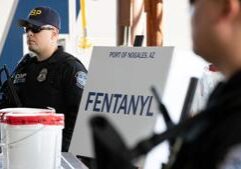
DEA warns fentanyl mixtures overwhelming overdose reversal drug
The U.S. Drug Enforcement Administration warned Americans Tuesday that fentanyl is increasingly mixed with a dangerous array of synthetic substances that can limit the effectiveness of naloxone, the standard overdose reversal drug, making the illicit drug supply more unpredictable and more lethal than ever.
Law enforcement and public health officials are seeing fentanyl combined with xylazine, medetomidine, nitazenes and cychlorphine – substances that either cannot be reversed by naloxone or require multiple doses to counter, the DEA said in a public safety advisory. Users typically have no way of knowing what is in the drugs they are taking.
The advisory arrives as the DEA and the Trump administration have been touting significant progress against fentanyl. Enforcement pressure drove the share of fentanyl pills containing a potentially lethal dose from 76% in fiscal 2023 to 29% in fiscal 2025, a result the agency has repeatedly cited as a win.
But the DEA’s own 2025 National Drug Threat Assessment warned that the declining purity trend “does not mean that street-level fentanyl is less dangerous,” pointing directly to adulteration as the compensating threat.
Congress is set to review a $3.6 billion DEA budget request for fiscal year 2027, part of more than $11.4 billion the Department of Justice is directing toward drug crimes – including $1.9 billion specifically targeting opioids such as fentanyl – as the agency now warns the threat is evolving faster than the progress it has claimed.
The DEA did not immediately respond to questions about what prompted the advisory, whether Mexican cartels are now involved in producing these combinations, or how the warning squares with the agency’s recent progress claims.
Xylazine and medetomidine are veterinary sedatives with no approved use in humans. Xylazine, known as “tranq,” has been linked to severe skin infections and wounds requiring amputation. Medetomidine, called “rhino tranq,” is 200 to 300 times more potent than xylazine, according to the DEA. Nitazenes are synthetic opioids developed in the 1950s that were never approved for human use; some variants are estimated to be 10 times more potent than fentanyl.
The DEA has identified 22 unique nitazene compounds since 2020, with suppliers introducing new ones each time existing compounds are scheduled.
Cychlorphine, named in Tuesday’s advisory, was flagged in a January 2026 public alert from the Center for Forensic Science Research and Education, a federally funded forensic research center, as a rising cause of fatal overdoses linked to confirmed deaths across eight states.
The center estimated cychlorphine to be about 10 times more potent than fentanyl. A November 2025 fatal overdose case in Illinois found cychlorphine alongside eight other substances – including multiple nitazene variants, cocaine, and alprazolam – illustrating how lethal these combinations can become, according to the CFSRE alert.
A pattern the center identified may help explain why cychlorphine is appearing more frequently. After China placed nitazene analogues under generic control in July 2025, positivity for nitazenes in fatal overdose cases declined – while cychlorphine positivity rose to fill the void, according to the CFSRE alert. The data suggests the illicit drug market is actively adapting to regulatory pressure, substituting newly emergent compounds as existing ones are controlled, according to the CFSRE alert.
As of the DEA’s most recent threat assessment, Mexican cartels had not been confirmed as producers of nitazene-fentanyl mixtures – that activity was traced to mid-level and street-level dealers purchasing from Chinese chemical suppliers online. Whether cartels have since expanded into these combinations is among the questions The Center Square put to the agency.
Overdose deaths have been declining. Provisional CDC data showed roughly 84,000 Americans died from drug overdoses in the 12-month period ending October 2024, down about 25% from the prior year, the largest single-year decline ever recorded.
The DEA urged the public never to take a pill not prescribed and dispensed by a licensed pharmacy, to assume all illicit drugs may contain fentanyl or other deadly additives, and to carry naloxone while understanding it may not fully reverse all substances present.






Sunny
Latest News Stories
Illinois quick hits: State rep. appointed circuit judge; Bailey to seek rematch with Pritzker

WATCH: IL governor on photo with wanted suspect: ‘No way to vet everybody’

Illinois quick hits: Constitutional amendment would guarantee parental rights
WATCH: Republican leader: says Pritzker budget cut EO a ploy for IL tax increases
Judge’s questions during IL gun ban arguments gives rights advocates ‘hope’

Illinois agencies to post monthly investment reports, lawmaker calls symbolic
JJC Board Approves Contract with Adjunct Faculty Union
JJC Board Approves Student Trustee Quorum Policy Amid Heated Debate

Meeting Summary and Briefs: Summit Hill School District 161 for August 13, 2025
Joliet Junior College, City of Joliet to Explore Joint Public Safety Institute
Summit Hill 161 Accepts a Dozen Resignations, Approves New Hires

Summit Hill 161 Approves $48K Tech Upgrade, Board Divided on New Teacher Hire