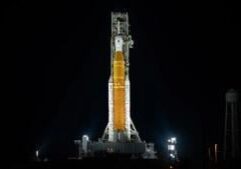
Lawmakers, administrator offer differing perspectives on proposed NASA budget
Republicans and Democrats came together in a rare moment of agreement on Capitol Hill Wednesday, saying NASA would not be able to carry out the Trump administration’s vision for the agency on the president’s proposed budget.
The Office of Management and Budget’s proposed budget for the agency for fiscal year 2027 is $18.8 billion, or an approximately 23% cut from amounts appropriated by Congress in 2026.
“I simply do not believe that this budget proposal is capable of supporting what President Trump himself has directed the agency to accomplish over the course of his two terms, nor what Congress has directed by law,” said Rep. Brian Babin, R-Texas.
“To be clear, I’m a conservative Republican. I am a budget hawk. Our nation is $39 trillion in debt. We must address this alarming situation and soon, but we must be smart in how we do so,” Babin added.
The Artemis II mission captivated the nation just weeks ago, as four astronauts traveled farther from Earth than any humans have ever flown and captured more data about the moon. But that’s just a small piece of President Donald Trump’s vision for the agency in the years to come.
The president’s National Space Policy calls for the U.S. to “lead the world in space exploration” and for Americans to land on the moon by 2028.
It includes starting the construction of a permanent crude base on the moon by 2030, “laying the foundations for lunar economic development,” replacing the International Space Station by 2030, deploying nuclear reactors on the moon and in orbit, and deploying the “first nuclear-powered interplanetary spacecraft” to Mars by the end of 2028.
Rep. Zoe Lofgren, D-Calif., the top-ranking Democrat on the House Committee on Science, Space and Technology, agreed with Babin, the committee’s chairman, that the proposed funding was insufficient to meet NASA’s objectives.
“Mr. Chairman, as you have said yourself, you are a conservative Republican from Texas. I’m not. But we see this the same way and I’m hopeful that we can work together and make sure that our country remains in the lead when it comes to space,” Lofgren said.
Despite lawmakers’ comments, NASA Administrator Jacob Isaacman – whom Trump nominated for the role, withdrew, and then nominated again – generally spoke positively of the president’s proposed budget.
“The president’s fiscal year ’27 budget, alongside the resources in the Working Families Tax Cuts Act, focus the agency on these priorities: return to the moon, increase launch cadence and land American astronauts on the surface by 2028 – consistent with the directive laid out in Executive Order 14369, ensuring American Space superiority, which was issued by President Trump last December,” Isaacman said.
In his testimony before the committee Wednesday, Isaacman said NASA achieved the “near impossible” for years but has largely fallen short of its potential over the past two decades, citing a 2025 Government Accountability Office report. He highlighted projects that had exceeded cost estimates and timelines in recent years.
The development of NASA’s Dragonfly project, which aims to send a car-sized, nuclear-powered octocopter (an eight-bladed drone) to Saturn’s largest moon, was initially projected to cost $850 million, with total costs around $1 billion. It had an initial target launch of 2026, but Isaacman said NASA is now “optimistic it will launch in 2028 at a cost of $3.4 billion.”
The first flight of the X-59 plane, which NASA began building in 2018, was supposed to take place in Jan. 2022 according to Isaacman, with a program price tag of $468 million. Instead, the first flight happened in Oct. 2025 and the program has cost close to $800 million to date.
He gave other examples of projects years behind schedule and hundreds of millions of dollars beyond initial estimates, seeming to suggest that NASA achieved less but blew through budgets and target dates under the Biden administration.
Making the proposed budget work comes down to “fixing the problems and concentrating resources on the mission and delivering outcomes,” according to Isaacman.
“If we can concentrate the resources entrusted to us on the needle-moving objectives and why we exist as an agency, while clearing away needless bureaucracy, obstacles and policies that impede progress, and unleash the brilliant minds at NASA, then returning to the moon and building a lunar base will be pale in comparison to what we can achieve in the years ahead,” Isaacman said.






Chance Rain Showers then Partly Sunny
Latest News Stories

Illinois quick hits: Bailey family announces memorial services; digital currency scam losses

Meeting Summary and Briefs: Village of Frankfort Board for October 20, 2025

Frankfort Park District Survey Shows Lack of Support for Top Rec Center Designs; Board Weighs Costly Referendum
Will County Health Department Pleads for $1 Million to Avert ‘Weakened Public Health System’

Judge: Benefits of feeding babies beat risk claims in NEC lawsuits
Frankfort Park District Approves Over $322,000 in August Bills
Frankfort Board Approves New Dump Truck Purchase, Sale of Surplus Vehicles
Frankfort Approves Over $203,000 for Holiday Lighting Contract
Meeting Summary and Briefs: Summit Hill School District 161 for October 15, 2025
Will County Committee Grapples with $8.9 Million Budget Gap After Contentious 0% Tax Levy Vote
Frankfort Earns Clean Audit, Receives National Finance Award for 35th Consecutive Year

Poll: Young adults not confident in 2026 election fairness