IL Supreme Court can’t just oust judges over speech: New filing
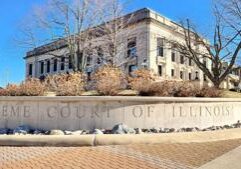
CHICAGO — The Illinois Supreme Court can’t both overstep the bounds of their constitutional authority by ousting a judge for publicly supporting President Trump, while also claiming they can’t be sued for that action because they were supposedly acting under their constitutional authority, said the ousted judge in a new court filing.
On April 17, former Cook County Judge James R. Brown filed a brief in Chicago federal court, pushing back on the attempt by Illinois’ state Supreme Court justices to abruptly end his legal action accusing them of trampling his constitutional rights and the limits of their authority in abruptly removing him from the bench in Cook County’s courts.
“Upon returning to the bench, Judge Brown was an Illinois Circuit Court judge, full stop. His decisions carried the same wait as every other judge on the Cook County Circuit Court,” Brown’s attorneys wrote in the April 17 brief. “Judge Brown and all retired judges recalled to judicial service are entitled to the same judicial disciplinary system as every other Illinois judge.
“Defendants (the Illinois Supreme Court) adjudicated judicial discipline against Judge Brown in clear absence of all jurisdiction.”
The filing comes as the latest step in a court fight that erupted in February, when Brown filed suit against the justices of the Illinois Supreme Court for their order removing him from a temporary judicial assignment to Cook County Circuit Court.
The lawsuit accuses the Democrat-dominated state high court of trampling his official rights as a judge and his constitutional speech rights as a citizen, by weaponizing Illinois’ judicial conduct code against him to suppress his speech and punish him for supporting President Donald Trump.
Brown is represented in the action by attorneys from the nonprofit constitutional rights advocacy group, the Liberty Justice Center, of Chicago.
Brown had retired from the Cook County Circuit Court in 2020, after 18 years on the bench.
However, the Illinois Supreme Court recalled Brown to active service five years later, appointing him to a temporary assignment on Cook County’s traffic courts in December 2025.
According to the Illinois Supreme Court at the time, Brown’s temporary appointment was needed to help Cook County’s overburdened courts deal with a shortage of judges amid a crush of backlogged cases.
However, in January 2026, the court suddenly decided to retract that assignment, amid a public pressure campaign mounted by Chicago Democrat lawyers.
At least two legal organizations, including the Cook County Bar Association, which represents the interests of black lawyers and judges in Chicago, and the Chicago Council of Lawyers issued statements and sent letters to the Illinois Supreme Court demanding the court rescind Brown’s appointment.
In those communications, the organizations claimed Brown had demonstrated himself to be unfit to hear cases in Cook County due to bias. As proof, they pointed to a column Brown published in an online publication operated by former Chicago Tribune columnist John Kass in September — four weeks before he applied for the judicial recall.
In that column, titled “His Judgment Cometh, and That Right Soon,” Brown assailed what he called “lawfare” waged by Democratic activists and politicians in Illinois and elsewhere in the U.S. against President Donald Trump and his supporters.
He further singled out for criticism the controversial criminal prosecutorial and policy decisions of former Cook County State’s Attorney Kim Foxx and other prosecutors, who Brown agreed had been propped up by billionaire left-wing activist George Soros and his political organizations to advance left-wing criminal justice reforms in Chicago and nationwide.
The complaining legal organizations asserted the column — which Brown authored and published when he was no longer a judge and before his recall — amounted to violations of the Illinois Code of Judicial Conduct, which require judges to “promote public confidence” in the courts.
The groups asserted the column was “wildly inappropriate for a member of the judiciary to be making” and showed Brown lacked “the temperament, judgment, independence, competence, impartiality and respect for the rule of law necessary for those who serve in the judiciary.”
After receiving the complaints from the lawyer associations, the Illinois Supreme Court then declared Brown’s appointment had been rescinded and he was removed from the bench.
In defending their action, the Illinois Supreme Court argued in federal court that they had the constitutional authority to act as they did, because they merely acted within their discretion and “ended his recall assignment.”
They argued that because the Illinois Supreme Court appointed Brown to the role, the court could also decide to end the assignment whenever it wished and for any reason, regardless of the otherwise lengthy and difficult process of removing nearly all other judges from the bench, even for ethical or criminal misconduct.
In its motion to dismiss filed April 3, the Illinois Supreme Court asserted the ouster was justified because Brown’s pro-Trump column violated Illinois judicial conduct rules, even though he wasn’t a judge at the time he wrote it. They further argued Brown’s pro-Trump statements made him unfit to serve as a judge hearing cases in heavily Democratic Cook County, even in cases involving traffic tickets.
In response, Brown and his legal team scoffed at such notions.
They reminded the federal judge that the Illinois state constitution makes plain that judicial discipline cannot be carried out unilaterally by the Illinois Supreme Court. And they noted that the Illinois Supreme Court has itself agreed with that conclusion in past decisions involving judicial discipline.
Rather, under the state constitution, judicial misconduct complaints are handled through a two-step process. First, complaints against judges are investigated by the Illinois Judicial Inquiry Board. Then, if the board establishes a judge likely violated the law or codes of judicial conduct, the matter is referred to the Illinois Courts Commission, which holds the sole authority under the state constitution, short of impeachment, to discipline or remove a state court judge from office.
The Illinois Supreme Court is not and cannot be involved in those decisions, Brown noted.
In this instance, Brown said, the Illinois Supreme Court has attempted to argue it could yet remove Brown from the court, because retired judges recalled to service by the Illinois Supreme Court differ from other elected or appointed state court judges, even those otherwise appointed by the Illinois Supreme Court.
The Illinois Supreme Court annually appoints dozens of lawyers in Illinois to serve as judges on county courts throughout the state, typically to fill vacancies left following a judicial retirement.
Some of these appointments have involved political figures who have expressed controversial or partisan political opinions before being appointed to the bench.
The high court, for instance, in October 2025, appointed former Illinois State Rep. Terra Costa Howard to the bench in suburban DuPage County. Howard, an outspoken progressive Democrat, had notably supported new constitutionally-questionable gun control laws and a state law that empowered the state to use Illinois’ consumer fraud law to pursue legal action against abortion opponents.
Further, Howard had notably attempted to push through legislation designed to ramp up government restrictions on homeschooling.
At the time of her appointment, conservative groups, including Illinois Family Action, voiced opposition to her appointment, saying Howard “as a very political and partisan legislator … has made it impossible … to properly maintain the appearance of, if not actual, judicial impartiality.”
Nonetheless, no bar organizations expressed any concerns about any “disruptions” Howard’s left-wing activism may bring to DuPage’s courts.
And Illinois Supreme Court Justice Mary K. O’Brien, who also had landed on the courts after a career as a progressive Democratic state lawmaker, declared she believed Howard would “uphold the rule of law and serve (DuPage County’s) citizens with distinction.”
In the April 17 brief, Brown did not reference the appointment of Costa Howard to the bench. But Brown’s brief did note that a current Illinois appeals court justice, Ramon Ocasio III continues to publish a regular column in the Chicago Daily Law Bulletin. Those columns, they note, have included controversial topics, including “‘the abolition of policing’ through the lens of the Native American ‘indigenous resistance’ who view police officers as ‘foot soldiers of US occupation, racism, and misogyny;’ the ‘pervasive influence of white supremacy’ evidenced in our ‘legal frameworks, societal norms, and economic systems’; the teaching of critical race theory in public schools; and referencing Defendant Chief Justice Neville Jr. to advocate for a more diverse judiciary.”
Yet, Brown noted, the justices “continue to let a sitting judge publish,” in what Brown asserts demonstrates a clear case of “viewpoint discrimination” against him.
Brown said the Illinois Supreme Court justices cannot claim immunity from his lawsuit, as his removal amounts to an unconstitutional action taken to unconstitutionally punish him for expressing views disfavored by the political power structure of Illinois.
And Brown pilloried the state Supreme Court justices’ attempt to argue his pro-Trump column had somehow “disrupted” proceedings in Cook County court.
He said the Illinois Supreme Court justices have yet to submit any evidence to back their assertion that “the public could reasonably question his (Brown’s) impartiality.”
“Defendants go as far as to claim, without a scintilla of evidence, that an unidentified ‘broad swath’ of 5.2 million people would ‘inevitably appear before Judge Brown’ and question his impartiality during his one-year term in Cook County Traffic Court,” Brown wrote. “If so, the Cook County Traffic Court must truly be a ‘high-volume’ courtroom.”
In his April 17 brief, Brown repeated his request that the federal court enter an injunction restoring him to the court, and ultimately rule that the Illinois Supreme Court violated his rights as a judge and an American citizen by retaliating against him for his speech.
“The judicial disciplinary system in Illinois is clearly established,” Brown wrote. “Defendants knowingly and purposefully circumvented that system to remove Judge Brown from the bench. In doing so, they violated Judge Brown’s First Amendment right to speak on a matter of public concern and Fourteenth Amendment right to due process as established by the Illinois Constitution.”
The case is assigned to U.S. District Judge Edmond E. Chang, an appointee of former President Barack Obama.
Chang has not yet ruled on either Brown’s motion for preliminary injunction, or the Illinois Supreme Court’s motion to dismiss his lawsuit.



Sunny
Latest News Stories

Lincoln-Way Board Approves Girls Flag Football for 2026-2027 Season

WATCH: Ives investigates tax dollars for NGOs; Republicans say Pritzker raising energy prices

ICE hiring ban bill reignites SAFE-T Act fight at Illinois Capitol

Executive Committee Advances Dissolution of Southeast Joliet Sanitary District

Meeting Summary and Briefs: Will County Board Legislative Committee for January 6, 2026

Medical device manufacturer invests $110M to expand Nebraska plant, boost drug supply
WATCH: U.S.ambassadors stress Greenland’s importance

Chicago council considers ‘not a tax’ surcharge on hotels

Govt. funding process advances as three more bills to become law; six remain
Bankers push back on Trump’s plan to reduce swipe fees, cap interest rates
State lawmaker calls for hearings on banning Sharia law in Texas

U.S. to build nuclear reactor on Moon by 2030, cost unknown