
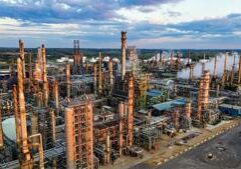
America’s motor fuel prices up, still below rest of the world
American prices for transportation fuels gasoline and diesel remained at four-year highs on Tuesday as the war with Iran moved into the 53rd day and the Strait of Hormuz remained mostly closed to vessel traffic.The national average price of a gallon of unleaded regular gasoline stood at $4.02, a 28.1% increase from $3.14 a gallon average at this time last year. National gasoline prices have averaged more than $4 per gallon for 22 consecutive days.The national average price of diesel fuel, used extensively to power industry, trucking, and railroads, has risen about 52% from the year prior to more than $5.51 a gallon on Tuesday. In Texas, Florida and Arizona, diesel costs have jumped by more than 60% year-over-year.“The near closure of the Strait of Hormuz really isn’t hitting the United States in terms of supply – because our supplies are reliable – but it does raise prices,” said David Blackmon, a veteran oil markets analyst and Forbes contributor, told The Center Square.U.S. supplies of crude oil and gasoline remain at near-normal levels, Energy Department data shows.Commercial crude inventories held in storage tanks in Oklahoma and across the United States are currently at 463.8 million barrels, which is about 1% above the five-year average for this time of year.While the Strategic Petroleum Reserve has been drawn down to roughly 409 million barrels to limit pressures on the U.S. prices, domestic production and stable imports from Canada and Mexico have prevented any physical fuel shortages.Blackmon said prices are higher in part because many of the refineries in the United States that convert crude oil to gasoline, diesel and other fuels were engineered during the last 50 years to process heavy oil produced in Venezuela and countries in the Middle East. The United States is the biggest producer globally, but much of the light sweet crude that flows from America’s shale basins is processed abroad and not by domestic refiners, he said.“We don’t have to be worried in the United States about long gas lines, a lack of gasoline supply or diesel supply, because we produce so much of our own oil and our imports are mainly from countries like Canada and Venezuela, Guyana, Mexico, and Brazil – other countries in the Western Hemisphere, in the Americas,” said Blackmon.According to the U.S. Department of Energy, the U.S. set a new annual production record in 2025, averaging 13.6 million barrels per day, fueled primarily by efficiency gains in the Permian Basin.U.S. crude oil production reached a record high 13.86 million barrels per day in October, but national output has declined in recent weeks to a near three-month-low 13.60 million barrels a day in the week that ended on April 10, according to the Energy Department.Blackmon said that since September 2008, when an American company drilled the first shale well in the Eagle Ford basin in Texas, the growth in U.S. oil production has been “incredible.”“From a base of about 3.6 million barrels of oil per day in 2008, we’ve added 10 million barrels of oil per day, which is the equivalent of adding the production of Saudi Arabia,” Blackmon said.While American drivers are feeling the pinch, costs remain significantly lower than in other global hubs like Paris and London, where high taxes push prices to approximately $8.20 and $7.50 per gallon, respectively. In Asian markets, consumers in Seoul paid $5.23 per gallon earlier this week, while the price in Tokyo sat at $4.75.In India, the government has shielded consumers by pressuring state-run refiners to freeze prices at approximately $3.86 per gallon in New Delhi, even as those companies reportedly lose nearly $200 million a day. This artificial stability stands in contrast to the U.S. market, where prices remain tethered to global volatility despite high domestic output.Ramping up U.S. production further would take time, even if companies chose to do so, according to University of Houston energy economist Ed Hirs. Individual firms make drilling decisions based on long-term price outlooks rather than short-term spikes, Hirs said. “Drilling in the shale basins is technically demanding,” Hirs told The Center Square. “Furthermore, it is difficult for these drillers to scale back up after the layoffs of the last few years, and it is currently hard to source enough steel, especially with the Trump administration’s tariffs in place.”Hirs also pointed to the ongoing releases from the Strategic Petroleum Reserve as a bridge that has helped to limit price spikes, providing a temporary cushion while the global market remains bottlenecked. Hirs warned, however, that these releases are a finite tool that cannot replace the long-term need for clearing the international shipping lanes.”The primary reason we are seeing such significant dislocations in pricing is that a massive portion of the world’s tanker fleet is bottled up behind the Strait of Hormuz,” Hirs said.He noted that while diesel recently hit $170 a barrel in Asia and jet fuel surged to $200, these prices are driven by logistics rather than a lack of raw crude.”If we could get those tankers out into the open ocean,” he said, “we would see these prices finally begin to settle out.”






Showers And Thunderstorms Likely
Latest News Stories

Lincoln-Way School Board Certifies Election, Re-elects Janik as President

New Electricity Contract to Save Lincoln-Way Over $500,000 Next Year

Four New Commissioners to Join Frankfort Square Park District Board in May

Meeting Briefs: Frankfort Square Park District for April 17, 2025

Lincoln-Way District 210 Board Briefs

Frankfort Township Board Unanimously Opposes Government Consolidation
Frankfort Township Upgrading Senior Apartments Amidst High Demand
- « Previous
- 1
- …
- 191
- 192
- 193