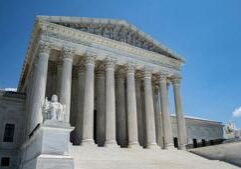
Legal experts anticipate SCOTUS will overturn drug user gun ban
Legal experts anticipate the U.S. Supreme Court will strike down a law barring unlawful drug users from possessing firearms.
On Monday, justices of the U.S. Supreme Court heard arguments in U.S. v. Hemani, a case challenging a law that prohibits a person who “is an unlawful user of or addicted to any controlled substance” from possessing a firearm.
Lawyers for Ali Hemani, a Texas man who was found possessing a gun, marijuana and cocaine, argued the law violated his Second Amendment rights. The Trump administration filed a petition to the Supreme Court to hear the case last year.
During the arguments, a majority of justices appeared skeptical of the law and the U.S. government’s petition to challenge it. The case came out of a standard developed from New York Rifle and Pistol Association, Inc. v. Bruen, that required modern gun laws be consistent with the historical tradition of firearm regulation.
The U.S. government argued this tradition applied in U.S. v. Hemani, based on founding era restrictions on “drunkards” participation in civil life. However, a majority of justices did not appear to be convinced of this argument.
Hayley Proctor, a professor of law at Notre Dame University, said many legal experts expected the majority of justices to be on the side of the government.
“The argument really dispelled that impression,” Proctor told The Center Square. “The court was asking very difficult questions of the government.”
The justices posed several hypotheticals of when an individual uses drugs unlawfully. Justice Amy Coney Barrett mentioned an example of a woman who uses her husband’s prescription Ambien to sleep.
“There can’t be a judgment there that simply using Ambien makes you dangerous,” Proctor said. “Unlawfulness is not the same thing as dangerousness.”
Lawyers for the U.S. government also argued the law could shift to only disarm individuals who possess Schedule I or Schedule II drugs. This would include marijuana, heroin, fentanyl and morphine. Proctor said relying on a federal scheduling to determine the law could be difficult because marijuana is being considered for rescheduling.
“The federal government has not fully enforced federal law on marijuana,” Proctor said. “So that plays into it.”
Lawyers for the Trump administration also argued that unlawful drug users pose a similar public safety threat as drunkards as the founding era did. However, legal experts said the justices were not convinced of this argument either.
“I don’t know that the reliance on the commitment laws, the vagrancy laws and the surety laws that the government seems to rely on here really captures the facts of this case and I think that’s why they struggled a lot with the questioning,” said F. Lee Francis, professor of law at the Widener Law Commonwealth.
The administration also pointed to founding era laws that disarmed British loyalists for rebellion against the colonies. Marc Levin, chief policy counsel at Right on Crime, said those arguments did not apply either, even though national security could be a concern in these kinds of cases.
“I kind of empathize to some degree with [the government’s] situation because it is really difficult to meet the standard that was set in Bruen, but I think it was designed that way,” Levin said.
Francis and Levin both pointed out that Justice Samuel Alito appeared to be in favor of the government’s argument in the case but said he appeared to be in the minority. Levin predicted the court would rule 8-1 to strike down the law and Francis guessed it would come out to 7-2, with Chief Justice John Roberts possibly joining Alito.
“I agree that the chief is on Alito’s side,” Levin said. “He likes to be part of the majority, so he might be able to find his way.”
The court is expected to release a decision in the consequential Second Amendment case by July.




Partly Sunny
Latest News Stories

‘Project Freedom’ begins, two ships safely transit Strait of Hormuz
Meeting Summary and Briefs: Lincoln-Way Community High School District 210 for April 16, 2026
Supreme Court declines hearing Chicago gun sales case

Meeting Summary and Briefs: Will County Board for April 16, 2026
Illinois Quick Hits: Google settlement wins praise from Illinois AG
Illinois diversity commission says businesses aren’t cooperating
U.S. House, Senate, governor on Ohio primary ballots Tuesday

Watchdog says healthcare providers may be misrepresenting child gender treatments as routine care

Everyday Economics: Inflation squeezes household spending

Hurricane season month away; forecast modest

Pentagon seeks $21B for barracks as repair backlog doubles

Lincoln-Way Updates Student Handbook, Bans “Smart Glasses” to Combat AI Cheating