
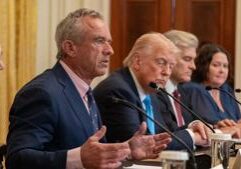
HHS and DOC announce nutrition education initiative for medical schools
Nutrition education for medical students will become more prominent in curriculum beginning this upcoming fall.
U.S. Department of Health and Human Services Secretary Robert F. Kennedy Jr. and U.S. Department of Education Secretary Linda E. McMahon announced the advancement of nutrition education for medical students on Thursday.
According to Kennedy, chronic disease is overwhelming America and is accelerating.
“Today, we spend $4.5 trillion a year on health care, and 90% of it goes to managing chronic disease,” Kennedy said.
According to McMahon, diet-related chronic diseases contribute to roughly 1 million deaths each year, impose enormous economic and emotional costs on the American population, and 14.7 million school-aged children currently suffer from obesity.
“Today’s announcement puts nutrition and prevention front and center in how we train tomorrow’s doctors and healthcare leaders,” McMahon said.
To improve the health of American citizens, the Health and Human Services and Education departments have created a taxpayer-funded initiative that 53 universities across 31 states will use to guarantee medical students learn more about nutritional health.
“The Department of Education will never mandate curriculum, that is not our job, but we can and will spotlight promising evidence-based models, convene leaders who are improving health outcomes, and celebrate institution-driven curriculum reforms that are reforming medical education,” McMahon said.
The HHS will invest $5 million taxpayer dollars through a multi-phase National Institues of Health nutrition education challenge, to support curriculum development and fund clinical training in gold standard science. The effort will expand beyond medical schools to residency programs, nursing dietitian and nutrition science programs nationwide.
“It has always been the goal of healthcare professionals to not just treat but to prevent disease,” Jeffry P. Gold, M.D., president of University of Nebraska System, said.
The Advancing Nutrition Education Across the Medical Continuum initiative readjusts curricumlum for health and nutrition benefit, ensuring medical students will be required 40 hours of comprehensive nutrition training prior to graduation. Prior to this initiative, less than two hours were required in some schools and 75% of schools did not require any hours.
“Nutrition has been treated as an elective in medical education,” Bobby Mukkamala, MD, president of the American Medical Association said. “It should be a basic foundational training, because it impacts every one of our patients.”
According to Kennedy, more than 30,000 physicians each year will now graduate equipped with nutrition education to help prevent, treat and reverse chronic disease.
“This is how we make America healthy again,” Kennedy said.
More information, including the schools that now follow the initiative, can be found at hhs.gov/nutrition-education.





Partly Sunny
Latest News Stories
Illinois, Chicago residents rank high taxes as state’s top issue

Illinois quick hits: Illinois House members vote along party lines; More than 40% of CPS teachers missed 10 or more school days; State Treasurer says Bright Start earns gold

Meeting Summary and Briefs: Will County Capital Improvements & IT Committee for November 4, 2025

Glock: Judge’s OK of Chicago’s anti-gun lawsuit questionable, at best

Illinois quick hits: DHS responds to migrant release order
Pritzker disagrees with Durbin on vote to end shutdown

Pritzker open to conversation with Trump on alderman’s immigration proposal

Expert: Illinois’ outdated tax law leaves homeowners, taxpayers on the hook

Illinois quick hits: Midway Blitz nabs nine drunk drivers; Madigan prosecutor to depart

Meeting Summary and Briefs: Frankfort School District 157-C for September 2025
Meeting Summary and Briefs: Frankfort Fire Protection District for September 2025

Lawmakers divided after federal complaint targets student mental health screening law

Normal, IL fire and EMS challenges highlight need for statewide task force

Analysis: Chicago among worst cities to drive in