Peotone 207U weighs school consolidation, finances, and next steps with public input front and center
By Andrea Arens
The Peotone Community Unit School District 207U Board of Education’s Committee of the Whole spent almost three hours discussing short-term consolidation plans, financial realities, and long-range facility considerations, with a strong emphasis on transparency and community involvement before any final decisions are made.
Short-term consolidation plan outlined
Assistant Superintendent Carole Zurales presented a short-term consolidation plan that could begin as early as the 2026-2027 school year, following recommendations from the district’s feasibility study conducted by Wight & Co.
Under the plan:
- Connor Shaw would house Pre-K through kindergarten
- Peotone Elementary School would serve grades 1–4
- Peotone Junior High would house grades 5–8
Zurales said the configuration meets Wight & Co.’s recommended space standards and would still allow for dedicated art and music classrooms, along with space for special education and instructional services.
Maps shown during the meeting were described as draft concepts only, not finalized classroom layouts.
Zurales noted that kindergarten scheduling would be best served at Connor Shaw, while moving fifth grade to the junior high could ease students’ transition into upper grades.
Board member Tim Stoub nodded, asking if the junior high has historically housed similar — or higher — enrollment levels.
“How does that number compare to years past? Have we had that many students in the building in the past?” Stoub asked.
Zurales and Superintendent Brandon Owens confirmed the building had previously supported comparable enrollment.
Financial impact and facility costs
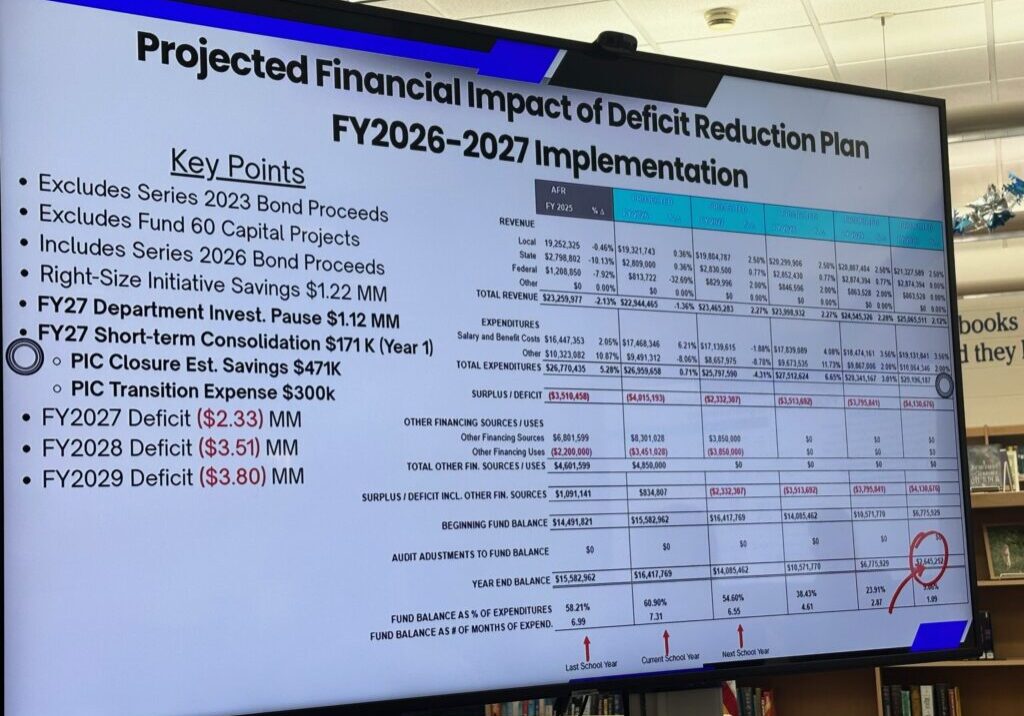
The proposed closure of the Peotone Intermediate Center (PIC) along with other cost reduction efforts would reduce the district’s projected deficit to $2.3 million in fiscal year 2027. The defcit would increase again the year after as other expenses that were paused in 26-27 are added back into the budget.
Buildings and Grounds Director Mike Singleton said preliminary estimates for the physical moves ranged from $127,000 to $250,000, depending on whether internal staff could be used. The plan would require relocating approximately 65 classrooms or offices.
Board member Mark Jones asked whether the square-footage targets were fully met. Zurales said both the elementary school and junior high were slightly under recommended space — by about three square feet per student.
Business Manager Adrian Fulgencio cautioned that enrollment projections exacerbate space constraints in later years, emphasizing the proposal is intended as a short-term solution.
Paused spending and deficit reduction strategy
Fulgencio reported that roughly $1.2 million in planned expenditures — including capital facility improvements, curriculum textbook purchases, and technology infrastructure upgrades — would be paused.
Jones questioned the benefit of delaying costs that would eventually be incurred.
Fulgencio said the pause is strategic, noting the district should avoid investing in buildings that may close or require reconfiguration.
Zurales echoed that sentiment regarding textbook purchases, saying the district needs to reassess enrollment and usage before making large investments.
Fulgencio added that closing PIC in fiscal year 2027 would save about $471,000 annually, offset by approximately $300,000 in closure costs, resulting in a net savings of $171,000. Combined with staffing “right-sizing,” the district’s deficit could drop from $3.8 million to $2.3 million.
Transportation and enrollment considerations
Board member Ashley Stachniak asked whether transportation savings were included. Fulgencio said the district estimates about $70,000 in transportation savings, reducing bus usage from 27 to 22 or 23 buses.
The district currently leases 40 buses at a cost of $780,000 annually through 2029, not including maintenance, tires, or fuel. The district employs its own full-time mechanic.
Stoub suggested renegotiating the lease to reduce costs sooner.
Fulgencio confirmed that projected overall expenses include inflation and noted that 2027 is the final year of the current union contract.
Stoub also asked whether the district would be required to file a state deficit reduction plan. Fulgencio said it is not currently required, but without adjustments, it could become necessary.
Jones expressed disappointment that closing a school would not result in larger deficit reductions.
Despite reservations, Stoub said closing PIC was “worthy to pursue,” and board member Jennifer Moe agreed that enrollment trends suggest the district may have reached that point.
Special education space concerns
Jones raised concerns about space for special education services. Discussion centered on a room currently used for pull-out services.
Stachniak said the room is used for segmented instruction periods, but Special Services Director Crystal Johnson pushed back, stating that students are taught in that space, not merely pulled out temporarily.
Safety concerns and road construction
Several board members pointed to planned widening of Monee-Manhattan Road as a major factor driving urgency.
“When that construction starts, you’re going to have 20-foot holes, heavy equipment, jackhammering — and it doesn’t matter if school is in session,” board member Bob Janeliunas said. “They’re starting.”
Stachniak added that safety concerns tied to the road project — not just finances — are a primary reason to consider closing PIC.
Community input emphasized
Board members repeatedly stressed the importance of meaningful community engagement before any final decision.
“I don’t want to see this community split in half anymore,” Stoub said. “If we try to force something, I don’t see it succeeding. We need to work collectively and make these hard decisions together.”
Board member Bob Janeliunas echoed that sentiment.
“I want to see something invested here for the long term,” Janeliunas said. “I just can’t sit around and do nothing and hope for something to come out of nowhere. We need to do the hard things until we get there together.”
Board member Steven Clark added, “This is just a step to get us to where we need to go in the right direction — getting the deficit closer to zero.”
Audience members noted that while about 30 people attended the feasibility meeting in person, online viewership of board meetings often reaches hundreds or even thousands.
“Just because people aren’t in these seats doesn’t mean they aren’t watching and engaged,” one participant said.
Public hearings scheduled
State law requires three public hearings before a school closure decision.
The board confirmed two dates:
- Friday February 13th at 5:30 p.m.
- Wednesday February 18th at 5:30 p.m.
A third hearing will be scheduled after evaluating attendance and feedback, ideally on a weekend.
Each hearing will be capped at 60 minutes or conclude once all speakers are heard. Written public comments will also be accepted via email or an online submission form. The regular board meeting will begin immediately following each hearing.
Working cash bonds and capital funds
The board also revisited how to handle working cash bond proceeds currently sitting in Fund 70, with borrowing capacity nearly maxed out.
Two options were discussed:
- Abating the bonds, using existing funds to make bond payments and freeing up borrowing capacity
- Defeasing the bonds, placing funds in escrow to pay off debt earlier but with less near-term flexibility
Board members showed no consensus toward either option while suggesting moving funds into Fund 60, which is restricted to capital projects.
Fulgencio explained that about $1 million currently sits in Fund 60, while roughly $4 million remains in Fund 70.
The board acknowledged the district would not move forward with the baseball and softball fields project at this time, though future capital use would remain flexible.
A formal resolution is expected to be considered at a future board meeting.
Appraisals and long-range ideas
Administrators presented appraisal quotes ranging from $6,000 to $8,400 to evaluate district properties.
The board agreed to pursue appraisals for two parcels — the intermediate center and the 27-acre property — but not Connor Shaw, since it remains in active use.
Exploratory discussions also touched on the possibility of a district-owned bus barn and broader facility consolidation concepts. Board members agreed those ideas should be addressed later through a comprehensive master facilities plan.
Looking ahead
While opinions varied on the pace and specifics, board members generally agreed on beginning the public hearing process while avoiding the perception that decisions have already been made.
“If we don’t make these important decisions, at some point we get forced,” Janeliunas said. “The community has options — and they have to tell us how they want us to proceed.”
The committee adjourned without taking formal votes, setting the stage for further discussion and community feedback in the weeks ahead.




Mostly Sunny
Latest News Stories

Summit Hill School Board Reverses Controversial Principal Non-Renewal Decision
Meeting Briefs: Summit Hill School District 161 for June 11, 2025
Will County to Draft New Harassment Policy Amid Debate Over Board Authority
Committee Uncovers Gaps in County Asset Tracking, Calls for Better System

Frankfort Park District in Dispute with Five Oaks HOA Over Park Development Rules

In Brief: Ordinance Review Committee Actions
Frankfort Park District Kicks Off Busy Summer Season with Races and New Events
Meeting Briefs: Frankfort Park District Board for June 10, 2025
Will County Jail Faces Major Staffing Crisis as 70 Employees Eligible to Retire by 2030
Will County Health Department Reports Sharp Decline in Overdose Deaths
Solar Project Extensions Approved as Industry Faces Permitting Delays
Committee Approves Truck Terminal Despite Residential Concerns