94% of sanctioned scholars suffered from free speech attacks
A Foundation for Individual Rights and Expression survey shows that 94% of sanctioned university scholars have experienced a negative impact following the attacks on their free speech, with conservative scholars receiving much less public support from their university colleagues or faculty union compared to liberals.
Foundation for Individual Rights and Expression (FIRE) research fellow and manager of polling and analytics Nathan Honeycutt told The Center Square: “What we heard from scholars about their experiences further reinforces how the academy needs courageous faculty willing to stand up for their colleagues, even when doing so is difficult or unpopular.
“It takes courage to seek, to listen, and to defend,” Honeycutt said. “But standing up for others is a test of integrity for higher education, and it’s a test the academy can’t afford to fail any longer.”
Senior Counsel Tyson Langhofer from legal organization Alliance Defending Freedom told The Center Square that FIRE’s poll “highlights a dangerous erosion of open inquiry in higher education.”
“When scholars fear speaking freely, universities cease to be places of learning and become echo chambers of conformity,” Langhofer said.
“The lack of support for conservative scholars, in particular, reveals an ideological imbalance on campuses that undermines intellectual diversity,” Langhofer said.
For its survey, FIRE talked with scholars “targeted for sanction because of their speech between 2020 and 2024.”
The results showed that 94% of these scholars have experienced a negative impact from attacks on their free speech.
Forty seven percent of the scholars said they lost professional relationships, 40% said they were shunned at work, 29% said their friends and family suffered collateral damage, and 20% said they lost employment.
Sixty eight percent of these scholars said they did not receive public support from their union, with a “noticeable partisan gap” found in the levels of support.
For instance, 40% of liberal scholars received “a moderate amount” of public support from university colleagues, versus 19% of conservatives. Additionally, 29% of liberal scholars received public support from their faculty union versus 7% of conservatives.
Interestingly, the general public outside of the academy gave more support to conservatives than liberals at 55% and 37%, respectively.
FIRE’s Nathan Honeycutt told The Center Square he believes “the responses from these scholars and their experiences further demonstrates that [the] cost of speaking freely can carry professional and personal risk.”
“Particularly given that those who should be speaking up in defense of speech and expression (at least for the scholars we heard from) have largely stayed silent,” Honeycutt said.
“Another implication that I think this survey speaks to is how the lack of support these scholars reported is reflective of a climate of isolation,” Honeycutt said.
Honeycutt explained this“will only further erode trust and narrow the scope of what is ‘acceptable’ or ‘safe’ to teach, discuss, or research.”
“Additionally, the experiences of these scholars likely creates a chilled climate for speech and expression,” Honeycutt said.
“When other scholars – including faculty or graduate students – witness the sanctions, terminations, isolation, and reputational collapse of those being targeted, and see nobody else speaking up, it likely becomes quite clear that silence is probably the best course of action,” Honeycutt said.
Langhofer told The Center Square that “universities must recommit to protecting all speech, even when it’s unpopular or controversial.”
“That means hiring faculty with diverse viewpoints, hosting civil debates, and enforcing rules against disruptive protests,” Langhofer said. “Most importantly, they must reject the false idea that words are ‘violence,’ which only fuels real hostility.”
“The growing tendency to label speech as ‘violence’ is dangerous and undermines the principles that make free societies thrive,” Langhofer said.
“Students must learn that disagreement is not an attack but an opportunity to think critically,” Langhofer said. “Protecting free expression on campus is crucial to ensuring that future generations choose dialogue over violence.
When asked how college campuses can become places that uphold freedom of speech, Nathan Honeycutt replied that “there are many ways.”
“Extending from this report one of the primary ways colleges and universities can better uphold the freedom of speech is by making the defense of speech and expression predictable, principled, and public,” Honeycutt said.
“Others do not have to agree with the speech or expression of every scholar being targeted, but there should be no question whether an institution will defend a scholar’s expression or work, or whether a scholar’s colleagues will speak up in defense,” Honeycutt said.
When reached, the ACLU was not able to provide comment in time for publishing.




Mostly Sunny
Latest News Stories

Chicago delays vote on parking meter sale, risks litigation
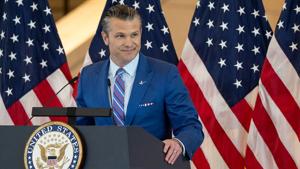
Hegseth’s ‘High-T’ troop screening mandate comes without cost estimate

Congressional candidates tackle housing, immigration

Senators to examine hospital price transparency legislation

Transit bill sponsor ok with recycled board appointments

U.S. adds 3.5M businesses despite shaky economy

Walmart targeted with lawsuit over customer service line voice recordings
Utility company pays $314 million to Eaton Fire victims

Illinois quick hits: Collinsville man pleads guilty to sex abuse of children
Judge plans to rule next week on Paramount, Warner Bros.
Aldermen say mayor fails to collect revenue he opposes

Texas leading in Iran conflict, drone boat company rescues pilots, attacks Iran