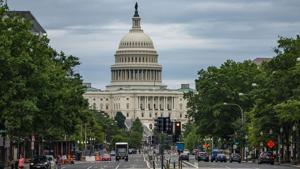
IL tax on billionaires’ ‘unrealized gains’ would face stiff constitutional test
While the provision may not ultimately be included in final legislation that Illinois Democrats ultimately enact to send hundreds of millions of dollars or more in new revenue to Chicago area public transit agencies, a headline-grabbing proposal to make Illinois the first state in the country to tax so-called “unrealized” asset gains has generated both public alarm and warnings any such unprecedented tax would almost certainly result in complex, high stakes constitutional legal challenges.
On Oct. 28, Illinois Democratic state lawmakers in the state House of Representatives suddenly filed legislation, as they seek to rush through a measure to address what Chicago area transit officials have warned is a desperate shortfall in money for train and bus services in the region.
The transit agencies, including the Chicago Transit Authority, Metra and Pace, have said without at least hundreds of millions of dollars in new revenue annually, they would be forced to severely cut services on which millions of people rely to travel to work, school, and other destinations in and around Chicago.
Illinois Democrats, including Gov. JB Pritzker, have pledged to address the shortfall yet this year, potentially during the fall veto legislative session, which ends Oct. 30.
On Oct. 30, Pritzker told reporters that talks were ongoing to pass a package of organizational reforms and new and increased taxes to address the transit problems.
However, it remains to be seen what combination of taxes may ultimately be included in the legislation.
If a group of Illinois House Democrats have their way, however, the package would include a combination of increased sales taxes, surcharges and new taxes on entertainment and amusement, and – perhaps most startingly – a so-called “billionaires’ tax.”
That new tax proposal would have imposed the state’s 4.95% flat income tax rate on assets held by billionaires. The tax, known as a “mark-to-market” tax, would specifically apply to so-called “unrealized gains” on the value of those assets, after the first $1 billion of estimated value.
If enacted, the tax would be the first of its kind implemented in any U.S. state.
To this point, income taxes have only ever been levied in the U.S. on so-called “realized income,” such as money earned in exchange for labor or services, interest earned from investments, or money received when selling or trading real property or securities, like stocks and bonds.
Democrats, particularly, have explored the possibility of taxing so-called “unrealized gains,” with the goal of increasing taxation on the wealthy, in particular.
However, such proposals on the federal level have consistently run into constitutional questions centered on whether the 16th Amendment to the U.S. Constitution permits Congress to tax “unrealized” income at all.
To this point, the U.S. Supreme Court has stopped short of answering that question directly. Recently, the high court stopped short of directly addressing the constitutionality of such taxation in a 2024 decision upholding the legality of a special tax provision enacted during the first term of President Donald Trump, imposing a special tax liability on so-called “repatriated income,” or money returned to the U.S. that had been held overseas.
However, such federal legal questions would likely have little bearing on the ability of states, like Illinois, to implement an unprecedented “unrealized gains” tax.
Observers have chided Illinois Democrats for introducing the legislation in such slapdash and rapid fashion, apparently seeking to use their supermajority status in Springfield to ram such a sweeping proposal through with minimal debate in the closing hours of a legislative session.
The rapid spin-up of the 1,000-page proposal has left even those well-schooled in state and federal constitutional law doubtful of their ability to digest and interpret the proposal, as yet.
Some law professors contacted by The Record, for instance, declined to talk about the proposal, citing the newness and breadth of the legislation, and the lack of time allowed by the Democratic lawmakers to take it in.
Other observers, however, predicted such legislation would face profound constitutional tests, particularly under the Illinois state constitution.
Joe Tabor, a legal analyst with the Illinois Policy Institute, predicted lawmakers would need to show the law did not run afoul of a key provision in the Illinois state constitution banning the state from taxing people at different rates, based on income.
“They’ll have to show they didn’t just invent new classifications of income to get around the flat tax requirement to artificially create a ‘progressive’ tax scheme that would otherwise not be allowed under the state constitution,” Tabor said.
Tabor and others further noted the proposal could violate state constitutional provisions prohibiting income from being taxed more than once and barring the state from taxing so-called “personal property,” or non-cash assets.
Under the proposed new tax, the state could require taxpayers hit with such a tax to annually estimate the value of stocks, bonds, ownership shares in a range of corporations, art and other collectibles, real property, and much more, even if the assets are never sold.
Jason Mazzone, a professor of constitutional law at the University of Illinois at Urbana-Champaign, said he believed that would likely be the primary constitutional sticking point for such a tax.
“The sponsors of the (legislation), which would impose a tax on unrealized gains on assets owned by state residents with net assets exceeding $1 billion in value, contend that the proposed new tax is not a tax on personal property but on income,” Mazzone wrote in an email answer to questions from The Record.
“The Illinois courts will be very skeptical of this claim for the simple reason that a gain on paper, without any money ever being exchanged, does not obviously count as income within the ordinary meaning of the word or in the world of financial management or taxation,” Mazzone said.
“An increase in wealth is quite different from an increase in income. The state constitution distinguishes between the two. Courts will be inclined to keep the line between them sharp.”
Mazzone said he believed courts would block the law on those grounds.
Ultimately, any such questions would most likely turn entirely on how the Illinois Supreme Court interprets such provisions of the Illinois state constitution.
That court is dominated by Democrats, who hold a 5-2 supermajority edge.
However, as of the evening of Oct. 30, it appeared the so-called “billionaire tax” would likely not win approval during this legislative session.
Gov. JB Pritzker, a billionaire in a family filled with billionaires, and also a powerful Illinois Democrat, had publicly indicated he did not support the proposal, at least in its current form.
Other observers said they did not believe the proposal could win approval in the Illinois state Senate.
Nonetheless, Democrats advanced the proposal out of the Illinois House Executive Committee on a straight 8-4 party line vote on Oct. 29. No further action had yet been taken on the proposal, according to a last check of the Illinois General Assembly legislative site, just before publication on Thursday evening, Oct. 30.
Tabor, however, cautioned that this does not necessarily mean the end for such a proposal.
“There definitely appears to be an appetite among Democrats, at least in the Illinois House, to do something like this,” Tabor said. “So we will have to wait and see if there will be another attempt to do something like this again.”






Mostly Sunny then Slight Chance Showers And Thunderstorms
Latest News Stories

Former HHS secretary tied to company that could benefit from CMS screening proposal
Supreme Court rules against Verizon, AT&T over privacy penalties

Illinois quick hits: Stop child care scams act clears U.S. House, Illinois U.S. Reps introduce immigrant due process bill

Trump to tap Blanche as attorney general

Trump signs executive orders on customs, federal workforce reforms

McCuskey eyes delay, reversal of furnace, water heater rules

Pratt, Bass on track to face each other in Nov. 3 mayoral race

Kiley, Wahab, Desmond hold onto leads in House districts

GOP maintains leads despite congressional redistricting

WATCH: Trump acknowledges Iranian hardliners could jeopardize deal

Advocates applaud, condemn SPLC wire fraud charges

Gallagher elected to serve rest of LaMalfa’s term in Congress