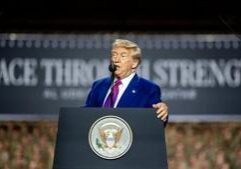
Trump says new 100% tariff on China as trade war escalates
President Donald Trump on Friday said imports from China will face a new 100% tariff “over and above” existing import taxes on the world’s second-largest economy.
Trump responded after an earlier tariff truce with China, when Beijing tightened restrictions on rare earth minerals. China holds most of the world’s rare earth minerals, crucial for advanced manufacturing, including military equipment, cars and electronics.
Trump announced the new tariffs in a Truth Social post.
The U.S. president called China’s restrictions on exporting rare earth minerals a hostile act against the rest of the world.
“This affects ALL Countries, without exception, and was obviously a plan devised by them years ago. It is absolutely unheard of in International Trade, and a moral disgrace in dealing with other Nations,” Trump wrote on Truth Social.
Since retaking the White House in January, Trump has levied import taxes on every U.S. trading partner to give U.S. companies a home-field advantage in the global market.
Trump said imports from China will face an added 100% tariff “over and above” the existing 30% rate. Tariffs at this level brought trade between the two superpowers to a near halt earlier this year before the two nations reached a truce in May.
In addition to the new tariffs, Trump said he would restrict U.S. exports of “critical software.”
“It is impossible to believe that China would have taken such an action, but they have, and the rest is History,” Trump wrote.
Earlier in the day, Trump said he might cancel a planned meeting with Xi Jinping.
“I have not spoken to President Xi because there was no reason to do so. This was a real surprise, not only to me, but to all the Leaders of the Free World. I was to meet President Xi in two weeks, at APEC, in South Korea, but now there seems to be no reason to do so,” Trump said.
Earlier this year, trade between the U.S. and China – the world’s two largest economies – came to a standstill after each country hit the other with tariffs above 100%. In May, the two nations reached a 90-day deal to continue talks. At the time, the U.S. said it would reduce its tariffs on China from 145% to 30% while the two nations continued to talk. China said it would cut its levies on U.S. imports from 125% to 10%. That truce was briefly disrupted in June over concerns about rare earth exports, but Trump later said the deal was back on track.
Economists, businesses and some publicly traded companies have warned that tariffs could raise prices on a wide range of consumer products throughout the U.S.
Trump has said he wants to use tariffs to restore manufacturing jobs lost to lower-wage countries in decades past, shift the tax burden away from U.S. families, and pay down the national debt.
A tariff is a tax on imported goods that the importer pays, not the producer. The importer pays the cost of the duties directly to U.S. Customs and Border Protection, a federal agency.
U.S. markets tanked Friday as tensions in the trade war escalated. The Dow Jones fell 1.9%, the NASDAQ shed 3.56% and the S&P lost 2.71%.




Sunny
Latest News Stories

Lawmaker responds to IL’s push for adult COVID shots against CDC guidance

Immigration advocates sue Trump administration over ‘unlawful’ ICE arrests

18% of med schools receive F when judged by academic excellence, DEI rejection

Plastics industry one of ‘most powerful economic engines’ thanks to nation’s shale gas, ingenuity

Congressional candidate defends ‘dark humor’ video about Kirk assassination
Trump tells parents to get vaccines not available in U.S.
Grocery tax stalls in Chicago council, measure approved in Bloomington

GOP leader argues against Democrats’ descriptions of ICE

Illinois quick hits: Guatemalan national guilty of illegal presence; ‘peacekeeper’ arrested for battery

Frankfort Board Denies Greenhouse and Pool Variances, Citing Zoning Intent and Setback Impact
Joliet Junior College Honors Seven Long-Serving Employees Upon Retirement
Trump tariffs drugs, furniture, heavy trucks to ‘protect’ U.S. markets