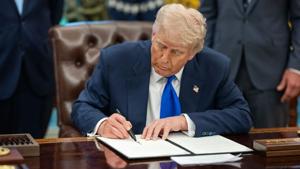
White House backs off hefty EU tariff threats, EU eliminates industrial tariffs
After striking a framework trade deal with the European Union in July, the White House added more details to what the agreement entails Thursday.
Most notably, President Donald Trump walked back threats of 250% and 100% tariffs on pharmaceuticals and semiconductors, respectively. Although a 15% baseline tariff was agreed upon between Trump and European Commission President Ursula von der Leyen in Scotland last month, the White House had not yet committed to including those two sectors in the lower tariff rate.
Thursday’s joint statement from the U.S. and EU provides a clearer picture of the trade framework, including that European pharma, semiconductors and lumber exports will be taxed at 15% beginning Sept. 1. The EU said they will bump their rate on all U.S. industrial goods down to 0%.
However, the tariff rate of 27.5% on European cars will stay in place until the EU eliminates tariffs on U.S. exports, at which time it will be reduced to 15%. Legislation must be passed in order to eliminate these tariffs.
The White House also announced that the EU would invest $600 billion in the U.S. and make $750 billion in energy purchases in the next three years.
White House trade advisor Peter Navarro touted the deal on Thursday as a win for the U.S., saying the new framework addresses a trade deficit with the EU.
“I can think of no deal more important than with the European Union,” Navarro said. “For many, many years, it has been taking unfair advantage of the United States.”
The EU acknowledged the White House’s position in the joint statement Thursday.
“[The trade framework] reflects acknowledgement by the European Union of the concerns of the United States and our joint determination to resolve our trade imbalances and unleash the full potential of our combined economic power,” the statement said.
Thursday’s announcement indicated that negotiations between the U.S. and EU will be ongoing, calling July’s trade deal “a first step in a process that can be further expanded over time.”



Mostly Sunny
Latest News Stories

U.S. Supreme Court to hear asylum, voting, pipeline cases next term

Illinois second in local fines and forfeitures

Report: Taxpayer dollars help nonprofit hospitals pad executive salaries, pay for lawsuits

Over 7 million student loan borrowers have 90 days to switch repayment plans
Pritzker signs 62 new laws, many not in effect until 2027
Federal workforce shrank by 256,000 in 2025. Deficit barely moved.

Illinois Quick Hits: Ruling supports Illinois mail-in ballot laws

Election 2026: Singular goal to win elections, different ideas to get there

Democratic group calls for U.S. social media ban for kids under 16
Colorado Dems seek to flip longtime GOP congressional seat

EXCLUSIVE: 14 state AGs confront insurance giant for prioritizing climate activism
U.S. Supreme Court agrees to hear Washington parental rights case