
U.S. national debt tops $37 trillion
Congress has spent more money than it has collected for the last two decades, allowing the U.S. debt to top $37 trillion for the first time.
Experts expected the U.S. to pass the $37 trillion mark months ago. The Treasury Department marked the milestone in a routine report.
Michael Peterson, CEO of the Peter G. Peterson Foundation, said federal spending remains unsustainable.
“Our national debt is now greater than the economies of the entire Eurozone and China, combined,” he said. “We are now adding a trillion more to the national debt every 5 months. That’s more than twice as fast as the average rate over the last 25 years.”
Peterson isn’t optimistic about Congress changing course.
“Our growing debt slowly damages our economy and the prospects of the next generation. As the government borrows trillion after trillion, it puts upward pressure on interest rates, adding costs for everyone and reducing private sector investment. Within the federal budget, the debt crowds out important priorities and creates a damaging cycle of more borrowing, more interest costs, and even more borrowing,” he said. “While the sheer size of our debt is shocking, it’s even more troubling that lawmakers continue to disregard the damage it does to our economy. The recent budget reconciliation package took our fiscal outlook from horrible to worse, adding more than $4 trillion to deficits over the next decade — or even more if temporary tax cuts are extended, or spending cuts are rolled back.”
Committee for a Responsible Federal Budget Maya MacGuineas called the figure “mind-boggling.”
“The gross national debt hitting $37 trillion is yet another stunning reminder of the terrible state of federal finances. Spending and revenue are woefully out of balance – to the tune of nearly $2 trillion annually and rising – and instead of addressing this imbalance, Congress keeps choosing to make things worse,” she said. “$37 trillion of debt is a mind-boggling figure that has little precedent. The more economically meaningful figure – debt held by the public as a share of output – is also approaching record levels. Our current debt is 100 percent of the economy – higher than any time other than just after World War II – and is rising rapidly.”
MacGuineas said Congress shows no signs of changing course on spending.
“To add insult to injury, we’re on course to spend $1 trillion this year just on interest costs,” she said. “Interest is now the second largest item in the budget, surpassing the entire defense budget as well as Medicare.”
Concord Action Executive Director Carolyn Bourdeaux said the U.S. debt is connected to the future of Social Security.
“This milestone comes at a time when Social Security faces a troubled future. This system is the foundation of older Americans’ dignity and prosperity, but the Old-Age and Survivors Insurance Trust Fund will become insolvent by 2033,” she said. “At that time, we will be forced to make hard choices: massive benefit cuts, major tax increases, or financing the system through even more debt, endangering the economic vitality of this country.”
She added: “The looming shortfalls in Social Security are intimately connected with our nation’s overall deteriorating fiscal outlook, and every year of delay makes the choices more difficult and the trade-offs more punishing.”
MacGuineas said she hoped it would serve as a wake-up call for lawmakers.
“Hopefully this milestone is enough to wake up policymakers to the reality that we need to do something, and we need to do it quickly,” she said.
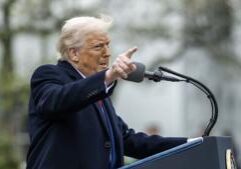
Trump has said he wants to use tariff revenue to pay down the national debt, although he’s also suggested other uses for that money, including rebate checks for Americans.
In March, the Congressional Budget Office’s said U.S. debt held by the public is on track to reach its highest level ever in 2029 before reaching 156% of gross domestic product in 2055. Gross domestic product is a measurement of economic output.
“Mounting debt would slow economic growth, push up interest payments to foreign holders of U.S. debt, and pose significant risks to the fiscal and economic outlook; it could also cause lawmakers to feel constrained in their policy choices,” the CBO report noted.
A Government Accountability Office report in January warned that unchecked spending could push public debt to 219% of GDP by 2051 and create a significant economic and national security risk.
“We project that public debt will reach an unprecedented level by 2027,” said Gene Dodaro, U.S. Comptroller General and head of the GAO. “We’re calling on Congress and the Administration to act now to develop and implement a strategy to address this acute challenge. Inaction could result in great difficulties for many Americans and impede policymakers’ flexibility to respond to future economic recessions or unexpected events.”






Showers And Thunderstorms Likely
Latest News Stories

Board Awards $242,500 Contract for Roof Repairs at Mary Drew Center

Will County P&Z: Wilton Township Wedding Venue Secured for 2026 Season

Frankfort Library Board Reviews Capital Wish List, Advances Reading Room Project

Chicago FOP boss: Mayor’s ICE on Notice order is ‘piece of toilet paper’

Summit Hill Board Approves $104,000 Snow Removal Bill Following Scrutiny Over Costs

Lawmaker, officer: ‘Blue Envelope” could help navigate autism during stops

WATCH: Supreme Court case could add to $10.8B midterm spending projection

Will County P&Z Grants Variances for Unpermitted Structures in Crete and Manhattan

Senate GOP fails to halt welfare funding for non-citizens

Senate passes funding deal, sends to House for final approval

California group opposes property tax hike, billionaires’ tax

Illinois quick hits: New Illinois Supreme Court justice installed

High schools throughout California stage walkouts over ICE
Pritzker celebrates expansion of French cheese maker in GOP leader’s district