Frankfort Village Board Approves Preliminary Plans for 133-Acre Frankfort Pointe Development Amid Resident Concerns
Frankfort Village Board Meeting | March 16, 2026
Article Summary: The Village Board approved rezoning and preliminary plans for a massive mixed-use industrial, commercial, and solar development on the village’s eastern border, citing the threat of de-annexation as a primary driver for maintaining local control.
Frankfort Pointe Key Points:
-
A 133.25-acre site at Harlem Avenue and Sauk Trail was rezoned from R-1 Residential to B-2 Community Business and I-1 Limited Industrial.
-
The development includes a 49.76-acre commercial solar energy facility, an industrial park, and a commercial “hard corner.”
-
Following extensive public comment regarding truck traffic, the Board amended the motion to remove the proposed Emoff Street connection to Harlem Avenue.
-
Village officials supported the project primarily to prevent the property from de-annexing into unincorporated Cook County, which would eliminate Frankfort’s regulatory control.
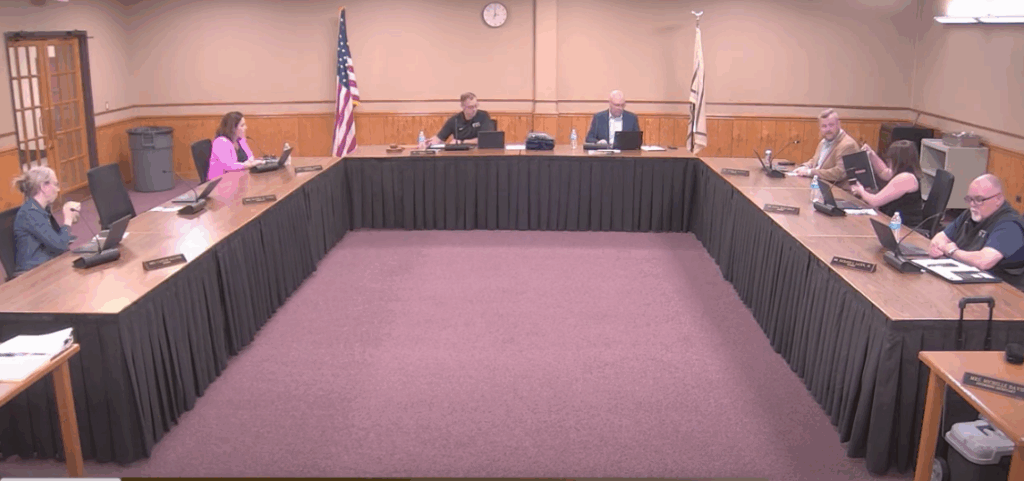
The Frankfort Village Board on Monday, March 16, 2026, approved a series of zoning requests and preliminary plans for Frankfort Pointe, a 14-lot light industrial, commercial, and solar Planned Unit Development (PUD) located at 7200 Sauk Trail.
The 133.25-acre parcel, proposed for development by Arete Design Studio, Ltd., sits at the southeast corner of Harlem Avenue and Sauk Trail. It is the only portion of the Village of Frankfort located within Cook County.
The preliminary plan dedicates approximately 9.37 acres at the corner for commercial development, 49.76 acres for a commercial solar energy facility to the south, and the eastern portion of the site for a 10-lot industrial park.
The proposal drew significant pushback from nearby residents in the Prestwick and Southwick subdivisions, as well as an objection from attorney Vincent Tessitore, representing Harlem Farm Properties to the south. Residents voiced concerns over increased truck traffic, the lack of continuous sidewalks, stormwater runoff, and the overall compatibility of an industrial park and solar facility near residential neighborhoods.
Tessitore argued that the proposed PUD sought blanket entitlements for future unknown users and requested broad zoning capacity. He also argued that creating specific permitted uses via a PUD agreement constituted an invalid abuse of zoning authority.
“Simply put, in my professional opinion, this is not lawful,” Tessitore told the Board. “This is, I think, what is known as legal contract zoning. Frankfort may attach conditions to a lawful PUD, but it cannot use a project-specific PUD development agreement to invent land uses that your ordinance itself does not recognize.”
Despite the public pushback, the Board voted 6-0 to approve the preliminary plans, citing a legal reality: if the Village denied the project, the developer possessed the legal criteria to de-annex the property from Frankfort and develop it under the less-restrictive standards of unincorporated Cook County.
“The alternative is to de-annex and they put up whatever they want, and we have no control over anything,” said Trustee Eugene Savaria. “If it happens, then, you know, we don’t control. If it’s high-density housing, they’re going to be coming to our schools because that’s the way it’s currently zoned, and they’re going to be paying Cook County taxes instead of our taxes. … The stance I’m taking is to kind of help you guys and try to protect you as much as possible.”
Trustee Adam Borrelli, acting as Mayor Pro-Tempore in the absence of Mayor Keith Ogle, noted that Cook County taxes residential properties at a lower rate for schools than Will County, effectively requiring Will County residents to subsidize the district. An industrial development, however, will inject substantial tax revenue into Frankfort School District 157-C and Lincoln-Way District 210 without adding students to the classroom.
According to estimates provided by the developer, the property currently generates roughly $2,400 annually in property taxes as farmland. At full build-out, the industrial park could generate over $1.5 million in tax revenue.
In response to resident and commissioner concerns, the Village Board heavily amended the preliminary approvals before the final vote. The most significant amendment was the complete removal of Emoff Street, an east-west road that would have connected the industrial park directly to Harlem Avenue. Trustees agreed that forcing all industrial traffic to exit onto Sauk Trail would mitigate truck impacts on the residential areas across Harlem Avenue.
The Board also amended the ordinances to require that the solar array be classified as a Special Use rather than a permitted use, removed a fencing setback exception to preserve the streetscape, mandated the preservation of existing landscaping along the south property line of the Lot 13 detention basin, and made the list of permitted uses strictly subject to legal review to ensure compliance with anti-contract-zoning laws.
Because the approvals were preliminary, the developers and any future tenants will still be required to return to the Plan Commission and Village Board for Final PUD approval for each individual lot before construction can begin.



Slight Chance Rain Showers then Slight Chance Showers And Thunderstorms
Latest News Stories

Meeting Briefs: Frankfort Township Board for May 19, 2025
Will County Board Rejects Two Solar Farm Projects After Heated Public Opposition
County Approves $15 Million Water System Takeover for Southeast Joliet Area
Board Postpones County Purchasing Code Overhaul Amid Union Contractor Debate
New Frankfort Square Park Board Takes Helm Amid Strong Financials, Maksymiak and Moore Elected Leaders
Animal Permit Hearing Reveals Neighborhood Disputes Over Horses, Roosters in Crete Township

Park District Awards Eight Scholarships to Lincoln-Way East Seniors
Transportation Projects Advance as Board Approves Vision Zero, Road Improvements
Health Department Receives Budget Boost, Sunny Hill Admission Policy Updated

Meeting Briefs: Frankfort Square Park District for May 15, 2025

Lincoln Way District 210 Achieves Highest Bond Rating in History
District Recognizes Outstanding Student Readers in Statewide Program